Author: Victor Medina & Mike Eberle | December 21, 2022

Summary

Many users of Legacy C-8 Aqueous Film Forming Foams (AFFF) are considering changing to foams to minimize release of PFOA, PFOS and 8:2 FTS. Modern C-6 AFFF and fluorine free foams (FFF) are replacement options. FFF is preferable from an environmental perspective, but current FFF formulations are inferior in firefighting characteristics to legacy C-8 AFFF and modern C-6 AFFF. In replacing the legacy C-8 foam, equipment decontamination is recommended. The process should be carefully planned and PFAS contaminated residuals properly managed.

Background

Legacy (AFFF) used for firefighting are a significant source of poly-, perfluoroalkyl substances (PFAS) in the environment. Key PFAS from these foams are discussed below:

  • Perfluorooctanoic acid (PFOA) and Perfluorooctanesulfonic acid (PFOS), which are long-chain C8 PFAS, have been the initial focus of regulatory criteria setting and some states have enforceable drinking water standards ranging from 8 to 70 nanograms per liter (ng/L). In 2022, the U.S. Environmental Protection Agency (EPA) issued lifetime drinking water health advisories of 0.0004 and 0.020 ng/L for PFOA & PFOS, respectively, and the EPA is expected to propose enforceable maximum contaminant levels (MCLs) for PFOA and PFOS in the near future.
  • 8:2-fluorotelomer sulfonate (8:2 FTS) is another long-chain C-8 PFAS that is currently not regulated in drinking water but readily transforms into PFOA.

AFFF is applied to fires via firefighting equipment. This includes fire extinguishers, firefighting vehicles and fixed systems (e.g., foam gun systems used to contain fires around tanks and fuel storage areas and foam dispersing systems). AFFF concentrate is placed in these devices and foam is generated by mixing the concentrate with water/air under pressure using specialized nozzles.

With current and expected regulation, many entities are exploring the process to replace their legacy AFFF (C-8) with other short-chain AFFF (C-6 fluorotelomer sulfonates) or fluorine free foams (FFF). This requires removal of the legacy AFFF and decontamination of the firefighting equipment. Cost analyses indicate that it is generally much less expensive to decontaminate firefighting equipment than it is to replace it. However, some replacement foams may differ in density/viscosity, which may require replacement of pumps, valves and/or nozzles, which would increase the decontamination costs. Very small systems and fire extinguishers would likely be less expensive to simply replace.

TRC reviewed processes and data from industrial decontamination efforts and papers/reports and studied research conducted by the Department of Defense Strategic Environmental Research & Development Program/Environmental Security Technology Certification Program (SERDP/ESTCP) to develop recommendations.

eed0fc79-fill-the-airplane-with-fire-fighting-foam-613905646-1024x683-1

Legacy AFFF Properties

Properties of legacy AFFF that make it very effective for fire suppression include:

  • The ability of the AFFF to form a thin, but stable, film on the water interface that smothers the fire. This film also prevents reignition
  • Viscosity and density similar to water, allowing for easy pumping and dispersal

Replacement Foams

There are two options available to replace legacy AFFF concentrate. (1) Modern Fluorotelomer AFFF, also called C-6 foam, uses short-chain fluorotelomer sulfonates and (2) Fluorine Free Foams (FFF) that use a variety of fluorine free organic surfactants. The table below compares these replacement options and legacy AFFF.

Replacement Foams Versus Legacy AFFF
Characteristics C-8 Legacy AFF Modern C- 6 AFFF FFF
Environmental Concerns High environmental concerns. Contains PFOA/PFOS or compounds that may transform to these compounds. Uncertain environmental concern. Does not contain or transform to PFOS/PFOA. Can transform to perfluoroheptanoic acid (PFHpA) that is regulated in several states. Very little environmental concern associated with PFAS but foam contains higher concentrations of hydrocarbon surfactants that could pose a risk if released to surface water. Overall concerns much lower than C-8 Legacy or C-6 AFFF.
Effectiveness of Suppressing Fuel/ Chemical Fires Excellent Comparable to C-8 Legacy AFFF Inferior to C-8/C-6 foams
Ability of Foams to Prevent Fire Reignition Excellent Comparable to C-8 Legacy AFFF Inferior to C-8/C-6 foams
Compatibility of Foams with Existing Firefighting Equipment Fully Compatible Highly compatible. Similar density and viscosity to C-8 Legacy AFFF

Low compatibility. Most have high viscosity and greater density. Existing pumps, valves and nozzles may need to be replaced.


From an environmental perspective, FFFs are preferential because of the uncertainty of the toxic characteristics of shorter chain C-6 PFAS compounds. In terms of fire suppression, modern C-6 fluorotelomer AFFF performs comparably to that of the C-8 legacy foams. FFFs may have utility for sites with isolated chemical fire hazards where longer extinguishing times are acceptable. However, most chemical fires will require replacement foams with extinguishing characteristics that C-6 fluorotelomer foams exhibit. There is substantial investment into the development of FFF, so it is possible that improved products will be available in the future. When switching foams, check for compatibility to existing pumps, valves and nozzles.

e7df91e7-in-the-grass-there-are-light-bulbs-1345611854

Learn More From Our Technical Experts

TRC’s Center of Research and Expertise (CORE) is a multidisciplinary team led by proven subject matter experts in over 30 specialized technical areas. Our monthly CORE newsletter shares valuable insights on emerging technologies, significant challenges and innovative solutions present in many industries across the world. Our experts also share how they use their unique skills and experience to solve client issues and support our communities and the environment.

Sign Up Today

Foam Removal and Decontamination

Foam removal and decontamination should be carefully planned. This includes estimating waste volumes (AFFF concentrate, flushes and rinsates), worker protection, sufficient storage capacity for residuals, leak minimization processes and eventual management and disposal of collected residuals.

The first step for replacement is removal of the legacy foam from the equipment. The foam can be removed via drains at low points in the system, and the removal should be carefully managed to minimize accidental releases.

There are currently no existing requirements for the decontamination of firefighting equipment at the federal level. TRC recommends that decontamination be conducted because residual C-8 foam in the system could result in mixing with the replacement foam and the subsequent release of C-8 PFAS to the environment when the new foam is applied. After draining the entire system of AFFF concentrate:

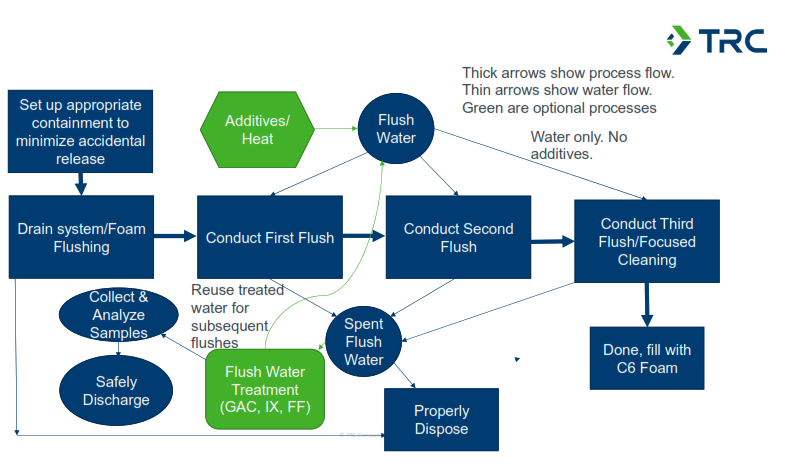
  • Conduct a foam flush, which is a rinse, or series of rinses, until foaming is no longer found in the rinsate.
  • Remove and replace disposable elements like bladders and hoses.
  • Consider conducting detailed, focused cleaning of valves, elbows, flanges and other elements that may be resistant to the flushing process or removing and replacing these.
  • Conduct triple or quadruple rinse to remove the majority of legacy PFAS contaminants. Each rinse should recirculate from 45 minutes to 1 hour before discharging and collecting.
  • The foam flush and rinsate water could be treated onsite to reduce the volume needed for disposal. Potential treatments include granular activated carbon (GAC), ion exchange (IX) or foam fractionation (FF).
  • Take care to minimize any leaks or accidental releases of the foam flush/rinsate. Collected rinsates should be stored with secondary containment prior to treatment or disposal.
  • Laboratory analysis of the final rinsate is an option, but is often not practical because of the need to return the firefighting equipment to service. Further, there are no established standards or advisories to meet.
  • Contaminated residuals (AFFF concentrate, rinsates, spent treatment media, etc.) should be managed appropriately.

Studies have shown that legacy PFAS can partition on surfaces in the firefighting equipment, including stainless steel materials. These can be released over time, causing “rebound.” If this is a concern, consider the following:

  • Commercially available additives can be used to improve the AFFF decontamination.
  • Solvents like methanol/ethanol or non-foaming surfactants could also be used to enhance decontamination efficiencies, although added solvents must be considered in the evaluation of disposal options.
  • For legacy C-8-based foams, heated water can be used to improve the mass transfer from the surfaces to the rinsate water.

Flushing Process Options
GettyImages-1256061373

Disposal of Residuals

Responsible disposal of the residuals should be conducted. As part of the planning process, discussed in the Foam Removal and Decontamination section, volumes of residuals should be estimated as part of the planning process and these estimates can be used to estimate disposal costs. Approaches for residuals management include incineration and landfilling with onsite methods under development. TRC can assist with making appropriate selections.

How Can TRC help?

If changeout of C-8 foam is desired, then TRC can assist in recommending a suitable foam replacement and develop plans for foam removal and equipment decontamination. TRC can assist in finding a quality contractor to conduct the foam removal and equipment decontamination and can develop plans to manage residuals from legacy foam removal and equipment decontamination. Contact our experts below to learn more.

Contact Us

Gain
Peace-of-Mind

Partner With TRC’s Tested Practitioners

Contact Us

Related Materials

Sharing Our Perspectives

Our practitioners share their insights and perspectives on the trends and challenges shaping the market.


GettyImages-2202100777
News

WSP to acquire TRC

December 15, 2025

Supercharges its leading position in the Power & Energy sector.

d0df0f31-environmental_protection_agency_building_in_washington-1131765355
Insights

TSCA Section 8(a)(7) PFAS Reporting and Recordkeeping

May 30, 2025

EPA has issued an eight-month extension for Toxic Substances Control Act (TSCA) reporting and recordkeeping requirements for per- and polyfluoroalkyl substances (PFAS).

Dry-kibble-pet-food.-Dog-or-cat-food-on-old-table-1498237967-753x502-1
Insights

Navigating the Legal and Regulatory Risks of Chemical Contaminants in Pet Food

November 14, 2024

Pet owners are increasingly focused on ensuring their companions maintain a nutritious diet.

Petrochemical-Plant-Illuminated-at-Dusk
Regulatory Updates

Changes to EPA’s Risk Management Program (RMP) Regulations Are Coming

April 14, 2023

Changes to the Risk Management Program (RMP) regulations were signed into a final rule on February 27, 2024, by EPA Administrator Michael S. Regan.

a6136fa8-gettyimages-1138436992
Regulatory Updates

EPA Finds Trichloroethylene Presents Unreasonable Risk in Final Risk Evaluation

April 6, 2023

On Jan 9, 2023, the United States Environmental Protection Agency (EPA) revised the Toxic Substance Control Act (TSCA) to reflect a new risk determination for trichloroethylene (TCE).

088350fb-man-filling-a-glass-of-filtered-water-right-from-the-tap-in-the-kitchen-1368715188-1
Insights

Proposed Use of a Hazard Index for PFAS National Primary Drinking Water Regulation (NPDWR)

April 4, 2023

The Proposed MCL and MCLG for the four PFAS, PFNA, PFHxS, GenX, and PFBS, considers their toxicity as additive. The EPA has proposed a HI of 1.0 as the MCL and MCLG for the four PFAS combined.

hands-shaking-in-the-field
Regulatory Updates

Using the R2 Guidance in Indiana

March 21, 2023

TRC outlines the new R2 Guidance in Indiana

6ce6b30e-gettyimages-1394199344
Insights

Setting the Stage for Effective Environmental Compliance Recordkeeping

March 21, 2023

Recordkeeping is an integral component of demonstrating compliance with environmental regulations.

badabb4a-engineers-showing-his-colleagues-online-data-in-tablet-1207928632
Insights

Routinely Evaluating the Health & Effectiveness of Integrated Systems to Manage EHS/ESG Risks – Part 2

March 15, 2023

Systematic monitoring and continuous improvement is important to achieve an effective EHS/ESG management system within an organization.

3256d36b-woman-labor-and-factory-exterio-858529688
Insights

Recognizing, Identifying, Prioritizing and Addressing EHS & ESG Risks

March 3, 2023

A clear view and understanding of the environmental, health and safety (EHS) risks created by a business is paramount to its success and longevity.

2612967a-two-heavy-industry-engineers-1290244410
Insights

Routinely Evaluating the Health & Effectiveness of Integrated Systems to Manage EHS/ESG Risks – Part I

March 1, 2023

Once established, an EHS/ESG management system must be routinely evaluated to ensure it remains effective to identify and control risks, as well as accommodate and adjust for changes that occur to/within the organization.

stacks
Regulatory Updates

Consequences of a Lowered NAAQS for PM2.5

February 16, 2023

TRC breaks down the significance of EPA lowering the NAAQS for PM₂.₅

78285eb8-trc-maysville-epa
Regulatory Updates

EPA Announces $2 Billion in Funding to Address Emerging Contaminants in Drinking Water

February 14, 2023

Environmental Protection Agency Administrator Michael Regan announced $2 Billion in infrastructure funding to help the nation’s rural water supplies.

Sluice Gate Water Canal
Regulatory Updates

EPA Publishes Effluent Guidelines Program Plan 15

February 14, 2023

The EPA announced updated effluent limitations guidelines under Plan 15, focusing on the evaluation and rulemaking process for per- and polyfluoroalkyl substances (PFAS) discharges.

esa-standard
Regulatory Updates

Phase I ESA ASTM Standard Update: The Wait is Over

December 21, 2022

The USEPA published a Final Rule making the ASTM E1527-21 Phase I ESA standard AAI compliant.

78179437-fire-truck-182819377-e1671572308266
Insights

Equipment Decontamination and Replacement of Legacy Aqueous Film Forming Foams

December 21, 2022

Legacy AFFF used for firefighting are a significant source of PFAS in the environment. With current and expected regulation, many entities are looking for replacements.

0f7b8139-coal-fired-power-plant-smoke-stacks-platte-river-casper-wyoming-wind-turbines-821028416
Insights

Preparing Your RMP Facility for a Future of Extreme Weather

November 29, 2022

Facilities dealing with hazardous materials must prepare for extreme weather events that pose a risk to their operations and the community.

business-and-statistics-concept
Insights

Data Requirements to Improve Statistical Decision Making

October 25, 2022

One goal of statistics is to draw meaningful inferences but your dataset must be large enough to provide technically-defensible and robust statistics.

904ccb51-power-plant-in-urban-area
Regulatory Updates

Proactive Enforcement is Key in the EPA FY2022-2026 Strategy

October 19, 2022

A core element of the EPA FY2022-2026 Strategic Plan focuses on environmental compliance.

3bfd18d9-highway-through-clevleand-oh-1162198844
Regulatory Updates

Preparing for EPA Inspections in Environmental Justice Communities

October 4, 2022

The EPA Office of Enforcement and Compliance Assurance Have Expanded Goals to Strengthen Enforcement and Protections Within EJ Communities

gettyimages-1256588029
Insights

A Green Future for Stormwater Management

September 26, 2022

Green Stormwater Management is an effective strategy for flood control and pollution mitigation.

gettyimages
Regulatory Updates

New National Emerging Contaminants Research Initiative

September 12, 2022

The Executive Office of the President of the United States announced a National Emerging Contaminant Research Initiative

c7e32b54-business-strategy-consulting-1186614184
Insights

Using Economic Impact Assessments to Share the Story of a Project or Facility

August 24, 2022

Economic Impact Assessments can demonstrate the positive effects a project has on the local economy.

GettyImages-534863741
Regulatory Updates

NERC Proposes Implementation Guidance for PRC-019-2

August 22, 2022

NERC has proposed implementation guidance for PRC-019-2, the standard that verifies coordination of generating unit facility or synchronous condenser voltage regulating controls, limit functions, equipment capabilities and protection system settings.

b585ce4f-ehs-white-paper-blog-e1677870757155
Insights

Optimizing EHS/ESG Information Management and Reporting Systems by Leveraging Innovative Digital Technology Solutions

August 10, 2022

A single, integrated enterprise wide EHS/ESG IMS can significantly improve performance and communicate progress towards organizational requirements and goals.

ec76f926-july-core-newsletter-image
Insights

Regulatory Compliance Items to Consider as Part of Transactional Due Diligence

July 19, 2022

Performing a limited environmental regulatory review can identify potential deficiencies with the environmental management of an acquisition.

transmission20lines20substations
Regulatory Updates

Revisions to FAC-001 and FAC-002 Submitted for FERC Approval

July 12, 2022

Reliability Standards FAC-001-4 and FAC-002-will resolve uncertainty regarding the meaning of “materially modify” under the currently effective standards.

GettyImages-1442960535
Insights

What Is an ESG Strategy and How Businesses Can Create One

July 7, 2022

All businesses seek profits, but today’s investors and shareholders want to see businesses making efforts to make the world a better place as they generate those profits.

silhouette-of-two-engineers-discussing-together
Regulatory Updates

FERC Order No. 881-A Has Implications for NERC Compliance Programs

June 23, 2022

Updated Order will have significant impact on NERC compliance programs related to both PRC standards and facilities ratings. Utilities should review the Order’s requirements and prepare for changes needed to remain compliant.

GettyImages-1419539600
Insights

ESG Social Criteria

June 22, 2022

ESG criteria involve many different factors. In this article, we look at the social aspect of ESG criteria. Contact TRC today to develop your ESG strategy!

04d8ea53-wastewater_photo
Insights

Integrating Sustainability, Digital Connectivity and Design Optimization in Wastewater Treatment Systems

June 20, 2022

Some organizations rarely think about water and wastewater treatment, until there is a problem. American industry depends on the ability to treat wastewater discharges while complying with regulatory standards and addressing emerging contaminants. If wastewater treatment fails, our environment is negatively impacted, and companies are exposed to shutdowns, delays and fines.

epa-strategic-plan-blog
Insights

Climate Action and Environmental Justice are at the Forefront of EPA’s Strategic Plan

June 14, 2022

The EPA issued its Fiscal Year 2022-2026 Strategic Plan. Although the strategic plans emphases often change with administrations, we can be reasonably certain that the Plan reflects priorities through 2024.

GettyImages-2163519478
Insights

What Are ESG Ratings and How Are They Given?

June 12, 2022

Your ESG rating can make or break your business’s attractiveness to investors. Learn more about ESG ratings and how they work with TRS Company!

c20ba008-microsoftteams-image-18
Insights

Support an Integrated EHS/ESG Management System

June 10, 2022

Supercharges its leading position in the Power & Energy sector Milestone transaction: To welcome a U.S. premier Power & Energy brand of approximately 8,000 people to create the #1 Power & Energy platform in the U.S1 (total cash purchase price of US$3.3 billion). Highly accretive: Expected to be low- to mid-single digit percentage accretive to WSP’s adjusted net earnings per share2 and high-single digit percentage accretive once cost synergies are fully realized2,3 Highly complementary: To expand our offering in the Power & Energy sector and provide potential cross-selling opportunities similar to our POWER Engineers experience. Drives scale across strategic high-growth areas fueled by strong fundamentals: o Grows Advisory capabilities o Expands Program Management expertise o Adds to Digital offering with innovative solutions o Enhances service offering across Water, Infrastructure and Environment Elevates leading position in the U.S.: Combined with TRC, WSP will become the largest engineering and design firm in the U.S. by revenue4, with approximately 27,000 employees. Provides further diversification: 34% of U.S. net revenues to be derived from the Power & Energy sector.5 Accelerates WSP’s organic growth rate profile globally: Approximately two-thirds of WSP’s global net revenues to be derived from Canada and the Americas, and approximately 20% from Power & Energy—a double-digit organic growth rate sector.6 Fully aligned with WSP’s 2025-2027 Global Strategic Action Plan: Pioneering change for empowered growth.  ~$850 million equity offering composed of $732 million bought deal and approximately $118 million concurrent private placement with La Caisse. NOT FOR RELEASE, PUBLICATION, OR DISTRIBUTION IN OR INTO THE UNITED STATES OF AMERICA OR TO ANY PERSON LOCATED OR RESIDENT IN THE UNITED STATES OF AMERICA, ITS TERRITORIES AND POSSESSIONS, ANY STATE OF THE UNITED STATES, OR THE DISTRICT OF COLUMBIA. BASE SHELF PROSPECTUS IS ACCESSIBLE, AND THE PROSPECTUS SUPPLEMENT WILL BE ACCESSIBLE WITHIN TWO BUSINESS DAYS, ON SEDAR+ MONTREAL, December 15, 2025 – WSP Global Inc. (TSX: WSP) (“WSP” or the “Corporation”), one of the world’s leading professional services firms, proudly announces it has entered into an agreement to acquire TRC Companies (“TRC”), a premier U.S. Power & Energy brand delivering end-to-end solutions that support the full infrastructure lifecycle (the “Acquisition”), currently majority-owned by funds managed by Warburg Pincus LLC. The proposed Acquisition, for a total cash purchase price of US$3.3 billion (approximately $4.5 billion based on the exchange rate of $1.3762 USD/CAD as of December 15, 2025), marks a significant step on WSP’s journey to achieve its 2025-2027 Global Strategic Action Plan. The proposed Acquisition will position WSP as the largest engineering and design firm in the U.S., supercharging its Power & Energy offering and enhancing its capabilities across Water, Infrastructure, and Environment. Based in Windsor, Connecticut, TRC has been a pioneer in adaptability and innovation for more than 55 years. TRC has established itself as a leader and recognized strategic advisor in the engineering and consulting industry, maintaining deep, long-term relationships with blue-chip utilities. Its team of approximately 8,000 employees offers an integrated approach that delivers long-term value for clients facing complex infrastructure and energy challenges. The proposed Acquisition complements WSP’s offering in attractive market sectors, will expand its client relationships, and enhance its capabilities throughout the project lifecycle, notably with a portfolio of advisory practices tailored to utilities and program management expertise. It will also create potential cross-selling opportunities across power engineering, environmental solutions, and advisory services. At the same time, TRC will bring a shared commitment to innovation and operational excellence, with investments in digital solutions and a highly skilled workforce—further amplifying WSP’s ability to deliver integrated, future-forward solutions. “The proposed Acquisition of TRC is a defining moment in the execution of WSP’s 2025-2027 Strategic Plan. Building on our track record of excellence and compounding financial performance, this strategic move will cement WSP as the Power & Energy consulting leader in the U.S. and globally. Joining forces will position our business for accelerated organic growth and create an integrated platform with industry-leading capabilities in advisory, engineering, and program management. With TRC’s highly complementary expertise in power delivery, transmission, distribution, and advisory services, our combined offering will cover the entire utility and infrastructure value chain. Together, we are poised to deliver more complex projects and offer expanded end-to-end services to help solve our clients’ critical needs, from aging infrastructure to grid modernization and electrification,” commented Alexandre L’Heureux, President and Chief Executive Officer of WSP. Also commenting on the Acquisition, Christopher P. Vincze, Chairman and Chief Executive Officer of TRC, said: “The joining of our two firms will create significant and exciting opportunities for our people, our clients and the communities in which we live and work. With TRC’s innovative, technology-oriented power business, underscored by an advanced use of digital, we will significantly strengthen WSP’s Power & Energy offering. Additionally, TRC’s globally recognized Environmental & Infrastructure business, which is the seed from which TRC grew, will enhance WSP’s capabilities across Water, Infrastructure and Environment. Our combined skill sets will elevate us to better support, over the next decade and beyond, our people and planet as we face unprecedented growth of power needs on the back of ongoing electrification, the re-emergence of domestic manufacturing in the U.S. and the continued growth of infrastructure. We were an early pioneer in the utility sector and continue to be a trusted thought partner, working to create, implement and manage complex strategies and programs to meet the country’s power needs. TRC’s people continue to be passionate about making the world a better place, and this next chapter will allow us to come together with WSP in a very exciting way to further that goal.” Reflecting on their investment, Kim Thomassin, Executive Vice President and Head of Québec at La Caisse said: “With this investment, La Caisse once again demonstrates its ongoing commitment to WSP, helping to position the company as a leader in engineering and design in the United States and globally, while accelerating the development of its Energy offering, a sector with strong potential. This transaction is at the core of our strategy to support the international expansion of companies firmly rooted in Québec and to give them the means to achieve sustainable growth.” FINANCIAL HIGHLIGHTS Proposed Acquisition of TRC for a total cash purchase price of US$3.3 billion approximately $4.5 billion based on the exchange rate of $3762 USD/CAD as of December 15, 2025). Acquisition price represents 14.5x TRC’s Pre-IFRS 16 CY2026E Adjusted EBITDA6 pre-synergies and 12.5x after including run-rate synergies.8 (TRC’s Pre-IFRS 16 Adjusted EBITDA and earnings before net interest and income tax for the financial year ended June 30, 2025 were approximately US$192.3 million ($268.5 million) and US$87.5 million ($122.1 million), respectively). Expected to be low-to-mid single-digit percentage accretive to WSP’s adjusted net earnings per share before synergies. WSP expects 2027 Accretion (as defined below) to be high single-digit percentage accretive once cost synergies are fully realized (WSP’s basic net earnings  per share attributable to shareholders and adjusted net earnings per share were $5.40 and $8.05 respectively, for the financial year ended December 31, 2024).2,9 Expected cost synergies to exceed 3% of TRC’s net revenues for the financial year ended June 30, 20257, plus potential cross-selling revenue synergy opportunities in alignment with our POWER Engineers experience (TRC’s net revenues and revenues for the financial year ended June 30, 2025 were approximately US$1,192.2 million and US$1,498.9 million, respectively). Transaction to be financed with US$3.3 billion of Committed Acquisition Financing (as defined below). Estimated pro forma Net Debt to Adjusted EBITDA ratio6 of ~2.4x upon closing of the Acquisition with the expectation to return to below 2.0x within 12 months6 (WSP’s net debt to adjusted EBITDA ratio for the nine-month period ended September 27, 2025 was 1.4x and adjusted EBITDA and earnings before net financing expense and income taxes for the trailing twelve-month period ended September 27, 2025 were approximately $2,501.4 million and $1,481.0 million, respectively).8 Equity raise of approximately $850 million: $732 million bought deal public offering and approximately $118 million private placement of common shares of WSP (“Common Shares”) expected to close on or about December 22, 2025, with a corresponding reduction of the amounts drawn from the Committed Acquisition Financing. WSP may also opportunistically access debt capital markets to repay a further portion of the Committed Acquisition Financing should market conditions be favourable. WEBCAST WSP will host a webcast today at 4:45 p.m. (Eastern Daylight Time) to discuss the Acquisition. Exceptionally, there will be no question-and-answer session, given the concurrent equity offering. To join the webcast, please register at https://www.icastpro.ca/rp92yd or access https://www.wsp.com/en-gl/investors. A presentation of the Acquisition is accessible on the webcast platform and under the “Investors” section of WSP’s website. CONDITIONS TO THE ACQUISITION Subject to the satisfaction of certain customary closing conditions, including applicable regulatory approvals, the Acquisition is expected to be completed in the first quarter of 2026. ACQUISITION FINANCING Equity Financing The Equity Financing (as defined below) comprises: $732 million bought deal public offering (the “Offering”) of common shares (the “Offering Common Shares”) at a price of $232.80 per Offering Common Share (the “Offer Price”); and Approximately $118 million private placement (the “Concurrent Private Placement” and together with the Offering, the “Equity Financing”) of common shares (the “Placement Common Shares”) at the Offer Price to Caisse de dépôt et placement du Québec (“La Caisse”) WSP intends to use the net proceeds from the Equity Financing to fund in part the purchase price payable in respect of the Acquisition (and related costs and expenses) and accordingly reduce amounts to be drawn on the closing of the Acquisition under the Committed Acquisition Financing to fund the purchase price for the Acquisition. Public Offering WSP has entered into an agreement with CIBC Capital Markets, BMO Capital Markets and National Bank Capital Markets (the “Joint Bookrunners”), on behalf of a syndicate of underwriters (the “Underwriters”), to issue and sell, on a “bought deal” basis, 3,145,000 Offering Common Shares at the Offer Price for gross proceeds to the Corporation of $732 million. The Corporation has granted the Underwriters an over-allotment option (the “Over-Allotment Option”), exercisable in whole or in part, for a period of 30 days following the date of the closing of the Offering to purchase up to an additional number of Offering Common Shares equal to 15% of the Offering Common Shares to be sold pursuant to the Offering at the Offer Price to cover over-allotments, if any, and for market stabilization purposes. The Offering Common Shares distributed pursuant to the Offering will be offered in all provinces and territories of Canada pursuant to a prospectus supplement (the “Prospectus Supplement”) to the short form base shelf prospectus of WSP dated August 8, 2024 (the “Base Shelf Prospectus”) to be filed by WSP on or about December 17, 2025, as well as in the United States by way of private placement to “qualified institutional buyers” in reliance upon the exemption from registration provided by Rule 144A under the U.S. Securities Act of 1933, as amended (the “1933 Act”). The completion of the Offering is subject to the approval of the Toronto Stock Exchange (the “TSX”). Closing of the Offering is expected to occur on or about December 22, 2025 and is conditional upon the concurrent completion of the Concurrent Private Placement. No securities regulatory authority has either approved or disapproved the contents of this press release. The Offering Common Shares have not been, and will not be, registered under the 1933 Act, or any state securities laws. Accordingly, the Offering Common Shares may not be offered or sold within the United States unless registered under the 1933 Act and applicable state securities laws or pursuant to exemptions from the registration requirements of the 1933 Act and applicable state securities laws. This press release shall not constitute an offer to sell or the solicitation of an offer to buy securities in the United States, nor shall there be any sale of the Offering Common Shares in any jurisdiction in which such offer, solicitation or sale would be unlawful. Delivery of the Prospectus Supplement, and any amendments to the documents will be provided in accordance with securities legislation relating to procedures for providing access to a shelf prospectus supplement, and any amendment. The Prospectus Supplement will be (within two business days of the date hereof) accessible on SEDAR+ at www.sedarplus.ca. An electronic or paper copy of the Prospectus Supplement, and any amendment to the documents, may be obtained without charge from CIBC Capital Markets at 161 Bay Street, 5th Floor, Toronto, ON M5J 2S8 or by telephone at 1-416-956-6378 or by email at mailbox.Canadianprospectus@cibc.com by providing the contact with an email address or address, as applicable. The Prospectus Supplement contains important, detailed information about the Corporation and the proposed Offering. Prospective investors should read the Prospectus Supplement (when filed) before making an investment decision. Concurrent Private Placement Concurrently with this announcement, WSP has also entered into a subscription agreement pursuant to which the Corporation will complete the Concurrent Private Placement at the Offer Price with La Caisse for aggregate gross proceeds to the Corporation of approximately $118 million. La Caisse has also been granted an option (the “Additional Subscription Option”) to purchase a number of additional Placement Common Shares representing up to 15% of the number of Placement Common Shares subscribed by them on closing, subject to, and in the same proportion as the Over-Allotment Option being exercised by the Underwriters. The issuance of the Placement Common Shares under the Concurrent Private Placement is subject to the approval of the TSX. Closing of the Concurrent Private Placement is scheduled to occur concurrently with the closing of the Offering and is conditional upon the concurrent completion of the Offering. Assuming completion of the Concurrent Private Placement and the Offering, but not the exercise of the Over-Allotment Option or the Additional Subscription Option, La Caisse will beneficially own, or exercise control or direction over, directly or indirectly, an aggregate of 18,619,100 Common Shares representing approximately 13.9% of the then issued and outstanding Common Shares. The Placement Common Shares will be subject to a four month hold from the closing date of the Concurrent Private Placement. In accordance with the terms of the Subscription Agreement, the Placement Common Shares will also be subject to contractual lockups for a period of four (4) months following the date of issuance of such Placement Common Shares. La Caisse (or their respective designee) will be entitled to a capital commitment fee equal to 4% of the aggregate purchase price for the Placement Common Shares for which they have subscribed (and any additional Placement Common Shares they have subscribed pursuant to the Additional Subscription Option, as applicable). Committed Acquisition Financing Concurrently with the announcement of the Acquisition, Canadian Imperial Bank of Commerce and JP Morgan Chase Bank, N.A., acting as co-lead arrangers and joint bookrunners, provided commitments for US$3,300 million senior unsecured non-revolving term loans (collectively, the “Committed Acquisition Financing”). The Committed Acquisition Financing will be governed by an incremental facility supplement to the Corporation’s seventh amended and restated credit agreement dated as of April 27, 2023, as amended and supplemented from time to time, with a syndicate of financial institutions to be entered into on or before the closing of the Acquisition. All of the above elements of the Acquisition financing plan have been designed and structured with a view to preserving WSP’s investment grade rating. Related Party Transaction Matters La Caisse beneficially owns, or has control or direction over, directly or indirectly, Common Shares representing more than 10% of the issued and outstanding Common Shares of WSP. As a result of the foregoing, the Concurrent Private Placement is a “related party transaction” for the purposes of Multilateral Instrument 61-101 – Protection of minority security holders in special transactions (“MI 61-101”). The Corporation has relied on the exemptions from the valuation and minority approvals of MI 61-101 contained in paragraphs 5.5(a) and 5.7(a) of MI 61-101 on the basis that neither the fair market value of the Concurrent Private Placement (including the capital commitment fee payable thereunder), nor the consideration thereof, exceeds 25% of the market capitalization of the Corporation. FINANCIAL AND LEGAL ADVISORS JP Morgan and CIBC Capital Markets are acting as financial advisors to WSP on the Acquisition. Legal advice is being provided to WSP by Skadden, Arps, Slate, Meagher & Flom LLP in the United States and Stikeman Elliott LLP in Canada. Harris Williams, UBS Investment Bank, AEC Advisors, and Houlihan Lokey are acting as financial advisors to TRC on the Acquisition. Legal advice is being provided to TRC by Paul, Weiss, Rifkind, Wharton & Garrison LLP. About TRC TRC stands for adaptability. With direction setting perspectives and partnerships, our 8,000+ tested practitioners in advisory, consulting, construction, engineering and management services deliver unique resolutions that answer any built or natural imperative. By creating new pathways for the world to thrive, we help our clients adapt to change and achieve long-lasting results while solving the challenges of making the Earth a better place to live — community by community and project by project. TRC is ranked #17 on ENR’s list of the Top 500 Design Firms, #5 for Power and #3 for Transmission & Distribution. Learn more at TRCcompanies.com and follow us on LinkedIn. About La Caisse At La Caisse, formerly CDPQ, we have invested for 60 years with a dual mandate: generate optimal long term returns for our 48 depositors, who represent over 6 million Quebecers, and contribute to Québec’s economic development. As a global investment group, we are active in the major financial markets, private equity, infrastructure, real estate and private credit. As at June 30, 2025, La Caisse’s net assets totalled CAD 496 billion. For more information, visit lacaisse.com or consult our LinkedIn or Instagram pages. La Caisse is a registered trademark of Caisse de dépôt et placement du Québec that is protected in Canada and other jurisdictions and licensed for use by its subsidiaries. About WSP WSP is one of the world’s leading professional services firms, uniting its engineering, advisory and science-based expertise to shape communities to advance humanity. From local beginnings to a globe-spanning presence today, WSP operates in over 50 countries and employs approximately 75,000 professionals, known as Visioneers. Together they pioneer solutions and deliver innovative projects in the transportation, infrastructure, environment, building, energy, water, and mining and metals sectors. WSP is publicly listed on the Toronto Stock Exchange (TSX:WSP). FORWARD-LOOKING STATEMENTS Certain information contained herein is not based on historical facts and may constitute forward-looking statements or forward-looking information under Canadian securities laws (collectively, “forward-looking statements”). Forward-looking statements may include estimates, plans, strategic ambitions, objectives, expectations, opinions, forecasts, projections, guidance, outlook, expectations regarding the requirements of various end markets, demand for and investments in power and energy related services and infrastructure, trends or other statements that are not statements of fact. Forward-looking statements made by the Corporation in this document may include statements about the Acquisition, the benefits, synergies and opportunities of the Acquisition, the Offering and the Concurrent Private Placement and the use of proceeds therefrom; the closing of the Offering and the Concurrent Private Placement; the conditions precedent to the closing of the Acquisition; the expected closing date of the Acquisition; the Committed Acquisition Financing, available liquidities, the attractiveness of the Acquisition from a financial perspective and expected accretion in various financial metrics (including estimated 2027 Accretion, Accretion Upon Closing of the Acquisition, TRC Pre-IFRS 16 Adjusted EBITDA and WSP’s Pro Forma Net Debt to Adjusted EBITDA ratio upon closing of the Acquisition and within 12 months following closing of the Acquisition); expectations regarding anticipated cost savings and synergies; the strength, complementarity and compatibility of TRC’s business with WSP’s existing business and teams; other anticipated benefits of the Acquisition and their expected impact on WSP’s delivery of its strategic plan and its long-term vision, future growth, results of operations, financial performance, business, prospects and opportunities, WSP’s business outlook, objectives, development, plans, integration, growth strategies and other strategic priorities, and WSP’s leadership position in its markets; and statements relating to WSP’s future growth, results of operations, performance business, prospects and opportunities, the expected synergies to be realized and certain expected financial ratios and other statements that are not historical facts.  Forward-looking statements can typically be identified by terminology such as “may,” “will,” “should,” “expect,” “plan,” “anticipate,” “believe,” “estimate,” “predict,” “forecast,” “project,” “intend,” “target,” “potential,” “continue” or the negative of these terms or terminology of a similar nature. Such forward-looking statements reflect current beliefs of Management and are based on certain factors and assumptions, which by their nature are subject to inherent risks and uncertainties. While the Corporation considers these factors and assumptions to be reasonable based on information available as at the date hereof, actual events or results could differ materially from the results, predictions, forecasts, conclusions or projections expressed or implied in the forward-looking statements. Forward-looking statements made by WSP are based on a number of assumptions believed by WSP to be reasonable as at the date hereof, including assumptions set out through this document and including, without limitation, principal assumptions about the satisfaction of all closing conditions and the successful completion of the Offering and the Concurrent Private Placement within the anticipated timeframe; the expected timing of completion of the Acquisition and the conditions precedent to the closing of the Acquisition (including the receipt of regulatory approvals); WSP’s ability to retain and attract new business, achieve synergies and maintain market position arising from successful integration plans relating to the Acquisition; WSP’s ability to otherwise complete the integration of TRC within anticipated time periods and at expected cost levels; WSP’s ability to attract and retain key employees in connection with the Acquisition; Management’s estimates and expectations in relation to future economic and business conditions and other factors in relation to the Acquisition and resulting impact on growth and accretion in various financial metrics; Management’s expectations in relation to the future performance and economic conditions and other factors in relation to TRC; the realization of the expected strategic, financial and other benefits of the Acquisition in the timeframe anticipated; the accuracy and completeness of the information (including financial information) provided by TRC and publicly available information; the absence of significant undisclosed costs or liabilities associated with the Acquisition; general economic and political conditions; organic growth expectations; economic and market assumptions regarding competition; the state of the global economy and the economies of the regions in which WSP or TRC operates; the state of and access to global and local capital and credit markets; interest rates; working capital requirements; the collection of accounts receivable; WSP obtaining new contract awards; the type of contracts entered into by WSP; the anticipated margins under new contract awards; the adequate utilization of WSP’s workforce; the ability of WSP to attract new clients; the ability of WSP to retain current clients; changes in contract performance; project delivery; WSP’s competitors; the ability of the Corporation to successfully integrate businesses; the acquisition and integration of businesses in the future; WSP’s ability to manage growth; external factors affecting the global operations of WSP; the state of WSP’s backlog and pipeline of opportunities in various reportable segments; the joint arrangements into which WSP has entered or will enter; capital investments made by the public and private sectors; relationships with suppliers and subconsultants; relationships with management, key professionals and other employees of WSP; the maintenance of sufficient insurance; the management of environmental, social and health and safety risks; the sufficiency of the WSP’s current and planned information systems, communications technology and other technology; the sufficiency of the Corporation’s cybersecurity measures; compliance with laws and regulations; future legal proceedings; the sufficiency of internal and disclosure controls; the regulatory environment; impairment of goodwill; foreign currency fluctuation; the expected benefits of acquisitions and the expected synergies to be realized as a result thereof; the tax legislation and regulations to which WSP is subject and the state of WSP’s benefit plans, as well as the assumptions underlying the 2025 financial outlook set out in WSP’s press releases dated February 12, 2025, August 6, 2025 and November 5, 2025. If any of these assumptions prove to be inaccurate, WSP’s actual results could differ materially from those expressed or implied in forward-looking statements. In evaluating these forward-looking statements, investors should specifically consider various risk factors, which, if realized, could cause WSP’s actual results or events to differ materially from those expressed or implied in forward-looking statements. Such risk factors include, but are not limited to: risks and uncertainties relating to the dilutive effect of the Offering on holders of Common Shares; the fact that the declaration of dividends on the Common Shares is at the discretion of the board of directors of WSP; the fact that the price at which the Common Shares under the Offering are sold by the Underwriters may be less than the Offering Price; WSP’s inability to successfully integrate TRC’s business upon completion of the Acquisition; the possible delay or failure to close the Acquisition; the potential failure to realize anticipated benefits from the Acquisition; the potential failure to obtain regulatory approvals in a timely manner, or at all; the currency exchange risk and foreign currency exposure related to the purchase price payable in respect of the Acquisition; WSP’s reliance upon publicly available information and information provided by TRC in connection with, and for the purposes of, the Acquisition; risks associated with historical and pro forma financial information; potential undisclosed costs or liabilities associated with the Acquisition; WSP’s or TRC’s businesses being adversely impacted during the pendency of the Acquisition; and change of control and other similar provisions and fees, as well as other risk factors discussed in greater detail in section 20, “Risk Factors,” of WSP’s Management Discussion and Analysis for the fourth quarter and year ended December 31, 2024 and in section 17, “Risk Factors,” of WSP’s Management Discussion and Analysis for the third quarter and nine-month period ended September 27, 2025, and as may be supplemented from time to time in reports filed by the Corporation with securities regulators or securities commissions or other documents that the Corporation makes public, which are available on SEDAR+ at www.sedarplus.ca and which sections are incorporated herein by reference into this cautionary statement. Although we have attempted to identify important risk factors that could cause actual results or events to differ materially from those contained in forward-looking statements, there may be other risk factors not presently known to us or that we presently believe are not material that could also cause actual results or future events to differ materially from those expressed in such forward-looking statements. WSP cautions that the foregoing list of risk factors is not exhaustive and other unknown or unpredictable factors could have also a material adverse effect on the performance or results of WSP or TRC. Actual results and events may be significantly different from what we currently expect because of the risks associated with our business, industry and global economy and of the assumptions made in relation to these risks. As such, there can be no assurance that actual results will be consistent with forward-looking statements. The completion of the Acquisition is subject to customary closing conditions, termination rights and other risks and uncertainties, including, without limitation and as applicable, regulatory approvals, and there can be no assurance that the Acquisition will be completed. There can also be no assurance that if the Acquisition is completed, the strategic and financial benefits expected to result from the Acquisition will be realized. To the extent any forward-looking statement in this document constitutes financial outlook or future-oriented financial information within the meaning of applicable Canadian securities laws, such information is intended to provide investors with information regarding the Corporation, including the Corporation’s assessment of future financial plans, and may not be appropriate for other purposes. Financial outlook (including assumptions about future events, including economic conditions and proposed courses of action, based on the Corporation’s assessment of the relevant information currently available), as with forward-looking statements generally, is based on current estimates, expectations and assumptions and is subject to inherent risks and uncertainties and other factors. Any financial outlook or future oriented financial information included in this document has been prepared by, and is the responsibility of, Management. PricewaterhouseCoopers LLP, the independent auditor of the Corporation, has not audited, reviewed, examined, compiled nor applied agreed-upon procedures with respect to any such financial outlook or future-oriented financial information and, accordingly, PricewaterhouseCoopers LLP does not express an opinion with respect thereto. The PricewaterhouseCoopers LLP report incorporated by reference in the Prospectus Supplement relates to the Corporation’s previously issued financial statements for the financial year ended December 31, 2024. It does not extend to any financial outlook or future-oriented financial information and should not be read to do so. Differences could arise because of events announced or completed after the date of this press release. All of the forward-looking statements contained in this document are expressly qualified in their entirety by this cautionary statement. The forward-looking statements contained in this document are made as of the date hereof (unless otherwise specified) and, accordingly, are subject to change after such date. Except to the extent required by applicable law, WSP does not assume any obligation to publicly update or to revise any forward-looking statements made in this document or otherwise, whether as a result of new information, future events, or otherwise. Readers should not place undue reliance on forward-looking statements. Readers are also referred to cautionary language regarding forward-looking statements included in the Prospectus Supplement. Additional Underlying Assumptions The Corporation cautions that the assumptions used to prepare the estimated 2027 Accretion, Accretion Upon Closing of the Acquisition, TRC Pre-IFRS 16 Adjusted EBITDA, TRC Post-IFRS 16 Adjusted EBITDA, and WSP’s Pro Forma Net Debt to Adjusted EBITDA ratio upon closing of the Acquisition and within 12 months following closing of the Acquisition could prove to be incorrect or inaccurate. Accordingly, the actual results could differ materially from the Corporation’s expectations as set out in this press release. The Corporation considered numerous economic and market assumptions regarding the foreign exchange rate, competition, political environment, and economic performance of each region where the Corporation and TRC operate. In addition to the assumptions disclosed above under “Forward-Looking Statements”, the following assumptions were used to develop these forward-looking financial measures: 2027 Accretion: WSP’s net revenue organic growth of approximately the same level as the average of the last three years for each of the years until 2027 (WSP’s revenue and net revenue were $16,166.8 million and $12,172.2 million, respectively, for the financial year ended December 31, 2024); TRC’s net revenue organic growth in line with the last 4-year compound annual growth rate (“CAGR”) revenue growth (TRC revenue and net revenue were approximately US$1,498.9 million and US$1,192.2 million, respectively for the financial year ended June 30, 2025); TRC Pre-IFRS 16 Adjusted EBITDA margin and Post-IFRS 16 Adjusted EBITDA margin expansion supported by a combination of levers, including utilization and pricing, where significant opportunity has been identified; Expected cost synergies of the Acquisition being fully realized by the end of 2027, with 50% expected to be realized in the first 12 months after closing of the Acquisition. Accretion Upon Closing of the Acquisition: The Acquisition is expected to be immediately accretive upon closing, excluding synergies. WSP’s net revenue organic growth of approximately the same level as the average of the last three years for each of the years until 2027 (WSP’s revenue and net revenue were $16,166.8 million and $12,172.2 million, respectively, for the financial year ended December 31, 2024);   TRC’s net revenue organic growth in line with the last 4-year compound annual growth rate (“CAGR”) revenue growth (TRC revenue and net revenue were approximately US$1,498.9 million and US$1,192.2 million, respectively for the financial year ended June 30, 2025);   TRC Pre-IFRS 16 Adjusted EBITDA margin and Post-IFRS 16 Adjusted EBITDA margin expansion supported by a combination of levers, including utilization and pricing, where significant opportunity has been identified. TRC Pre-IFRS-16 Adjusted EBITDA and TRC Post-IFRS 16 Adjusted EBITDA: TRC high single digit revenue organic growth for the financial year ending December 31, 2026, in line with TRC’s actual performance for the last four years. TRC Pre-IFRS 16 Adjusted EBITDA margin and Post-IFRS 16 Adjusted EBITDA margin expansion supported by a combination of levers, including utilization and pricing, where significant opportunity has been identified; WSP’s Pro Forma Net Debt to Adjusted EBITDA ratio (upon closing of the Acquisition, and a targeted range within 12 months following closing of the Acquisition): Acquisition closing date assumed to be March 28, 2026; WSP’s Adjusted EBITDA2 for the financial year ending December 31, 2025 ranging from $2.54 billion to $2.56 billion10; TRC’s Post-IFRS 16 Adjusted EBITDA for the financial year ending June 30, 2026 being in line with TRC’s actual performance of the first 3 months of the financial year ending June 30, 2026; All elements of WSP’s consolidated statements of cash flows for the applicable period being in line with those generally experienced by WSP in comparable periods; WSP’s net revenue between $13.8 billion and $14.0 billion for the financial year ending December 31, 2025 (WSP’s net revenue was $12,172.2 million for the financial year ended December 31, 2024, and WSP’s revenue was $16,166.8 million for the financial year ended December 31, 2024); and Cash flow of TRC for the financial year ending June 30, 2026 being in line with TRC Pre-IFRS 16 Adjusted EBITDA for the first 3 months of the financial year ending June 30, 2026. NON-IFRS AND OTHER FINANCIAL MEASURES The Corporation reports its financial results in accordance with International Accounting Standard 34 Interim Financial Reporting. WSP uses a number of financial measures when assessing its results and measuring overall performance. Some of these financial measures are not calculated in accordance with International Financial Reporting Standards Accounting Standards (“IFRS”). Regulation 52-112 respecting Non-GAAP and Other Financial Measures Disclosure prescribes disclosure requirements that apply to the following types of measures used by the Corporation: (i) non-IFRS financial measures; (ii) non-IFRS ratios; (iii) total of segments measures; (iv) capital management measures; and (v) supplementary financial measures. In this document, the following non-IFRS and other financial measures may be used by the Corporation: 2027 Accretion; Accretion Upon Closing of the Acquisition; Net Revenues; Net Revenue Organic Growth, Adjusted EBITDA; Adjusted Net Earnings; Adjusted Net Earnings Per hare; and Net Debt to Adjusted EBITDA ratio. Other than in respect of 2027 Accretion and Accretion Upon Closing of the Acquisition which are each defined below, explanations of the composition and usefulness of these measures can be found in section 19, “Glossary of segment reporting measures, non-IFRS and other financial measures” of WSP’s MD&A for the third quarter and nine-month period ended September 27, 2025 (the “Q3 2025 MD&A”), which section is incorporated by reference in this document, as posted on WSP’s website at www.wsp.com, and filed on SEDAR+ at www.sedarplus.ca. Reconciliations of such measures to the most directly comparable measure under IFRS are provided in section 8, “Financial Review” and section 9, “Liquidity” in each of WSP’s MD&A for the second quarter and six-month period ended June 29, 2024, WSP’s MD&A for the third quarter and nine-month period ended September 28, 2024, WSP’s MD&A for the fourth quarter and year ended December 31, 2024 (the “2024 MD&A”), WSP’s MD&A for the second quarter and six-month period ended June 28, 2025 and in the Q3 2025 MD&A, which sections are also incorporated by reference in this document, as posted on WSP’s website at www.wsp.com, and filed on SEDAR+ at www.sedarplus.ca. The information in this document also includes non-U.S. GAAP financial measures and non-U.S. GAAP financial ratios with respect to TRC, namely TRC Net Revenues, TRC Pre-IFRS 16 Adjusted EBITDA, TRC Post-IFRS 16 Adjusted EBITDA, TRC Pre-IFRS 16 Adjusted EBITDA margin and TRC Post-IFRS 16 Adjusted EBITDA margin. These measures are not recognized measures under U.S. GAAP and do not have standardized meanings prescribed by U.S. GAAP and therefore may not be comparable to similar measures presented by other companies, including WSP’s. Rather, these measures are provided as additional information to complement U.S. GAAP measures by providing further understanding of TRC’s results of operations. Accordingly, these measures should not be considered in isolation nor as a substitute for analysis of TRC’s financial statements reported under U.S. GAAP. WSP discloses TRC Pre-IFRS 16 Adjusted EBITDA because this non-U.S. GAAP measure is a key measure used by TRC to evaluate its business, measure its operating performance and make strategic decisions. WSP believes TRC Pre-IFRS 16 Adjusted EBITDA is useful for investors and others in understanding and evaluating its operations results in the same manner as TRC. However, TRC Pre-IFRS 16 Adjusted EBITDA is not a financial measure calculated in accordance with U.S. GAAP and should not be considered as a substitute for net income, income before income taxes, or any other operating performance measure calculated in accordance with U.S. GAAP. Using this non-U.S. GAAP financial measure to analyze TRC’s business would have material limitations because the calculations are based on the subjective determination of Management regarding the nature and classification of events and circumstances that investors may find significant. In addition, although other companies in its industry may report measures titled adjusted EBITDA or similar measures, such non-U.S. GAAP financial measures may be calculated differently from how TRC calculates non-U.S. GAAP financial measures, which reduces their overall usefulness as comparative measures. Because of these limitations, you should consider these non-U.S. GAAP financial measures alongside other financial performance measures, including net income and TRC’s other financial results presented in accordance with U.S. GAAP. These measures are defined as follows: “TRC Net Revenues” has the same definition as WSP’s definition of “net revenues,” being revenues less direct costs for subconsultants and other direct expenses that are recoverable directly from clients. “TRC Pre-IFRS 16 Adjusted EBITDA” is defined as TRC earnings before net interest and income taxes, excluding depreciation, amortization and acquisition and integration expenses and unusual items. “TRC Post-IFRS 16 Adjusted EBITDA” is defined as the TRC Pre-IFRS 16 Adjusted EBITDA adjusted for operating lease costs. “TRC Pre-IFRS 16 Adjusted EBITDA margin” is defined as the TRC Pre-IFRS 16 Adjusted EBITDA, divided by TRC Net Revenues. “TRC Post-IFRS 16 Adjusted EBITDA margin” is defined as the TRC Post-IFRS 16 Adjusted EBITDA, divided by TRC Net Revenues. WSP uses the following non-IFRS and other financial measures in this document with respect to the Corporation, in each case on a pro-forma basis after giving effect to the Acquisition, the Offering, the Concurrent Private Placement, advances and funds expected to be drawn under the Committed Acquisition Financing and any Acquisition related adjustments, as if each had been completed at the beginning of the relevant period: “WSP Pro Forma Adjusted EBITDA,” for the purpose of calculating the WSP Pro Forma Net Debt to Adjusted EBITDA ratio; “WSP Pro Forma Net Debt to Adjusted EBITDA ratio”; and  “WSP Pro Forma Net Revenues”. “2027 Accretion” or “accretive” is calculated as the increase in WSP’s forecasted pro forma adjusted net earnings per share for the financial year ending December 31, 2027 after giving effect to the Acquisition, the Offering, the Concurrent Private Placement, advances and funds expected to be drawn under the Committed Acquisition Financing and any Acquisition-related adjustments, as if it had been completed on January 1, 2027, as compared to WSP’s forecasted adjusted net earnings per share for the financial year ending December 31, 2027 on a stand-alone basis. Refer to “Additional Underlying Assumptions” in this document. “Accretion Upon Closing of the Acquisition” is calculated as the increase in WSP’s forecasted pro forma adjusted net earnings per share immediately after giving effect to the Acquisition, the Offering, the Concurrent Private Placement, advances and funds expected to be drawn under the Committed Acquisition Financing and any Acquisition-related adjustments, as compared to WSP’s forecasted adjusted net earnings per share on a stand-alone basis. Refer to “Additional Underlying Assumptions” in this document. A reconciliation of TRC earnings before net interest and income tax to TRC Pre-IFRS 16 Adjusted EBITDA and TRC Post-IFRS 16 Adjusted EBITDA for the financial year ended June 30, 2025, is provided in the table below:   Financial year ended June 30,2025 (in million U.S. dollars) Earnings before net interest and income taxes 87.5 Depreciation 13.8 Amortization 73.1 Acquisition and integration expenses and unusual items 17.9   TRC Pre-IFRS 16 Adjusted EBITDA   192.3 Operating lease costs (IFRS 16 Adjustment) 14.9 TRC Post-IFRS 16 Adjusted EBITDA11 207.2   A reconciliation of TRC Revenues to TRC Net Revenues for the financial year ended June 30, 2025, is provided in the table below:   Financial year ended June 30,2025 (in million U.S. dollars) Revenues 1,498.9 Subconsultants and direct costs (306.7) TRC Net Revenues12 1,192.2   A reconciliation of WSP’s Pro Forma Net Revenues for the trailing twelve months ended September 27, 2025 for WSP and financial year ended June 30, 2025 for TRC, is provided in the table below:   Trailing Twelve months ended September 27, 2025 (in million U.S. dollars) WSP Net revenues* 13,680.4 TRC Net Revenues (for the financial year ended June 30, 2025 and converted into Canadian dollars) 1,663.4 WSP Pro Forma Net Revenues 15,343.8 * Total of segments measure     A reconciliation of WSP’s Pro Forma Adjusted EBITDA for the trailing twelve months ended June 28, 2025 for WSP and financial year ended June 30, 2025 for TRC, is provided in the table below:   Trailing Twelve months ended September 27, 2025 (in million U.S. dollars) WSP Adjusted EBITDA 2,501.4 TRC Post-IFRS 16 Adjusted EBITDA (for the financial year ended June 30, 2025 and converted into Canadian dollars) 289.2 WSP Pro Forma Adjusted EBITDA 2,790.6   A reconciliation of WSP’s Pro Forma Net Revenues for the trailing twelve months ended June 28, 2025 for WSP and financial year ended June 30, 2025 for TRC, is provided in the table below:   Trailing Twelve months ended June 28, 2025 (in million U.S. dollars) WSP Net revenues* 13,214.2 TRC Net revenues (for the financial year ended June 30, 2025 and converted into Canadian dollars) 1,663.4 WSP Pro Forma Net Revenues 14,877.6 * *Total of segments measure     A reconciliation of WSP’s Pro Forma Adjusted EBITDA for the trailing twelve months ended June 28, 2025 for WSP and financial year ended June 30, 2025 for TRC, is provided in the table below:   Trailing Twelve months ended June 28, 2025 (in million U.S. dollars) WSP Adjusted EBITDA 2,386.4 TRC Post-IFRS 16 Adjusted EBITDA (for the financial year ended June 30, 2025 and converted into Canadian dollars) 289.2 WSP Pro Forma Adjusted EBITDA 2,675.6   The non-IFRS and other financial measures used in this document do not have a standardized meaning as prescribed by IFRS. Management of the Corporation believes that these non-IFRS and other financial measures provide useful information to investors regarding the financial condition and results of operations of the Corporation and the other entities referenced herein as they provide additional key metrics of their performance. Refer to section 19 “Glossary of segment reporting, non-IFRS and other financial measures” of the Q3 2025 MD&A for more information on the usefulness to investors of each such measures. These non-IFRS and other financial measures are not recognized under IFRS, do not have any standardized meanings prescribed under IFRS and may differ from similar computations as reported by other issuers, and accordingly may not be comparable. These measures should not be viewed as a substitute for the related financial information prepared in accordance with IFRS. PRESENTATION OF FINANCIAL INFORMATION Unless otherwise indicated, all references to “$” in this document are to Canadian dollars and all references to “US$” refer to United States dollars. Where financial information of TRC has been converted from U.S. dollars to Canadian dollars for purposes of comparison to and combination with, financial information of WSP, U.S. dollars have been converted to Canadian dollars at an exchange rate of $1.3952 Canadian dollars per US$1.00. TRC’s financial statements were prepared in accordance with U.S. generally accepted accounting principles (“U.S. GAAP”). IFRS differs in certain material respects from U.S. GAAP. The financial information of TRC presented in this document has not been adjusted to give effect to the differences between U.S. GAAP and IFRS or to accounting policies that comply with IFRS and as applied by WSP, nor has such financial information been conformed from accounting principles under U.S. GAAP to IFRS as issued by the IASB, and thus may not be directly comparable to WSP’s financial information prepared in accordance with IFRS. We have assessed the differences between U.S. GAAP and IFRS for TRC and have determined the impact to be immaterial except for Lease Accounting. Under IFRS, Lease Accounting is governed by IFRS 16 while under U.S. GAAP, it is governed by Accounting Standard Codification (ASC) 842. While similar with regards to the recognition of leases on the balance sheet, the standards have many differences in application. However, the impact of the differences between U.S. GAAP and IFRS for Lease Accounting on the pro forma financial measures presented in this document, namely WSP Pro Forma Net Revenue and WSP Pro Forma Adjusted EBITDA, is immaterial, such that no adjustments would be necessary. WSP’s financial information for the trailing 12-month period ended June 28, 2025 presented herein has been derived by adding WSP’s unaudited interim consolidated financial information for the six-month period ended June 28, 2025 to its audited consolidated financial information for the financial year ended December 31, 2024, and subtracting its unaudited interim consolidated financial information for the six-month period ended June 29, 2024. WSP’s financial information for the trailing 12-month period ended September 27, 2025, presented herein has been derived by adding WSP’s unaudited interim consolidated financial information for the nine-month period ended September 27, 2025 to its audited consolidated financial information for financial year ended December 31, 2024, and subtracting its unaudited interim consolidated financial information for the nine-month period ended September 28, 2024. NO OFFER OR SOLICITATION No securities regulatory authority has either approved or disapproved the contents of this press release. For more information, please contact: Alain Michaud Chief Financial Officer WSP Global Inc. alain.michaud@wsp.com (438) 843-731   1 Based on Engineering News-Record’s (ENR) Top 20 U.S. Design Firms by Sector (Power) list in August 2025, calculated on U.S. domestic revenues (U.S. Revenues) and adjusted to reflect annualization of POWER Engineers, Incorporated’s contribution for the financial year ended December 31, 2024, the assumed completion of the Acquisition as well as WSP U.S. Pro Forma Revenues. The approximate number of employees is as at December 2, 2025. 2 Non-IFRS financial measure or non-IFRS financial ratio that is forward-looking, without a standardized definition under IFRS, which may not be comparable to similar measures or ratios used by other issuers. Please refer to the “Non-IFRS and Other Financial Measures” and “Forward-Looking Statements” disclaimers below. For the financial year ended December 31, 2024, WSP’s adjusted EBITDA was $2,185.7 million, basic net earnings per share attributable to shareholders was $5.40 and adjusted net earnings per share was $8.05. 3 Cost synergies to exceed 3% of TRC’s net revenue are expected to be achieved by the end of 2027, with 50% expected to be realized in the first 12 months after closing of the Acquisition. The cost to realize synergies is estimated at the same level of synergies. 4 Based on ENR’s Top 500 U.S. Design Firms list in August 2025, calculated on U.S. Revenues and adjusted to reflect annualization of POWER Engineers’ contribution for the financial year ended December 31, 2024, the assumed completion of the Acquisition as well as WSP U.S. Pro Forma Revenues. Please refer to the “Forward-Looking Statements” disclaimer below. 5 Based on WSP U.S.’s Power and Energy net revenues for the trailing twelve-month (TTM) period ended June 28, 2025, and TRC’s Power and Energy net revenues for the financial year ended June 30, 2025. USD/CAD exchange rate used to convert TRC net revenue Power and Energy sector into Canadian dollars is 1.3952. Please refer to the “Non-IFRS and Other Financial Measures” and “Forward-Looking Statements” disclaimers below. 6 Pro forma Net Revenues are for the trailing twelve-month period ended June 28, 2025 for WSP, adjusted to reflect annualization of POWER Engineers’ contribution for the financial year ended December 31, 2024 and the assumed completion of the Acquisition. Please refer to the “Forward-Looking Statements” disclaimer below. 7 Non-IFRS financial measure or non-IFRS ratio that is forward-looking, without a standardized definition under IFRS, which may not be comparable to similar measures or ratios used by other issuers. Please refer to the “Non-IFRS and Other Financial Measures” and “Forward-Looking Statements” disclaimers below. 8 Cost synergies to exceed 3% of TRC’s net revenue for the financial year ended June 30, 2025 are expected to be achieved by the end of 2027, with 50% expected to be realized in the first 12 months after closing of the Acquisition. The cost to realize synergies is estimated at the same level of synergies. 9 The Corporation’s assessment of potential synergy opportunities for the Acquisition is primarily based on the information received as part of its due diligence investigation of TRC, its own outside-in perspectives, previous acquisition experience and publicly available information. 10 The target ranges were prepared assuming no fluctuations in foreign exchange rates in markets in which the Corporation operates. The Corporation anticipates organic growth in net revenues by segment will be in the mid-to-high single digits in its Canadian operations, mid single digit growth for its Americas operations, mid-single digits growth in EMEIA and low-to-mid single digit organic contraction in APAC. Head office corporate costs in 2025 are expected to be between $145 million and $160 million. 11 TRC pre-IFRS 16 Adjusted EBITDA and TRC Post-IFRS 16 Adjusted EBITDA for the financial year ended June 30, 2025 are not including the pro forma annualized contribution of acquisitions completed during the 2025 exercise. If we include the annualized contribution of these acquisitions, the pro forma TRC Pre-IFRS 16 Adjusted EBITDA and TRC Post-IFRS 16 Adjusted EBITDA would have been $US196.8M and $US211.7M, respectively. 12 TRC net revenues for the financial year ended June 30, 2025 are not including the proforma annualized contribution of acquisitions completed during the June 30, 2025 financial year-end. If we include the annualized contribution of these acquisitions, the pro forma TRC net revenues would have been $US 1,206.8M.

electric-industrial-power-station-windmill-and-sola
Regulatory Updates

NERC’s Revised PRC-024-3 Standard for Inverter-Based Generation Effective in October 2022

May 11, 2022

Changes to PRC-024-3 in support of inverter-based generation performance are going into effect in October of this year. Interconnection programs and documentation procedures may need to be updated in order to maintain compliance.

GettyImages-989229564
Regulatory Updates

FERC Issues Notice of Inquiry Regarding Dynamic Line Ratings

April 25, 2022

There are significant technical challenges involved in implementing Dynamic Line Ratings in the planning and operation of utility systems. Utilities should be prepared to modify their NERC compliance programs as necessary to address the potential introduction of DLR in their businesses.

b517ce45-manage-ehs-esg-risks-blog
Insights

How to Use an Integrated Approach To Manage EHS and ESG Risks

April 20, 2022

Supercharges its leading position in the Power & Energy sector Milestone transaction: To welcome a U.S. premier Power & Energy brand of approximately 8,000 people to create the #1 Power & Energy platform in the U.S1 (total cash purchase price of US$3.3 billion). Highly accretive: Expected to be low- to mid-single digit percentage accretive to WSP’s adjusted net earnings per share2 and high-single digit percentage accretive once cost synergies are fully realized2,3 Highly complementary: To expand our offering in the Power & Energy sector and provide potential cross-selling opportunities similar to our POWER Engineers experience. Drives scale across strategic high-growth areas fueled by strong fundamentals: o Grows Advisory capabilities o Expands Program Management expertise o Adds to Digital offering with innovative solutions o Enhances service offering across Water, Infrastructure and Environment Elevates leading position in the U.S.: Combined with TRC, WSP will become the largest engineering and design firm in the U.S. by revenue4, with approximately 27,000 employees. Provides further diversification: 34% of U.S. net revenues to be derived from the Power & Energy sector.5 Accelerates WSP’s organic growth rate profile globally: Approximately two-thirds of WSP’s global net revenues to be derived from Canada and the Americas, and approximately 20% from Power & Energy—a double-digit organic growth rate sector.6 Fully aligned with WSP’s 2025-2027 Global Strategic Action Plan: Pioneering change for empowered growth.  ~$850 million equity offering composed of $732 million bought deal and approximately $118 million concurrent private placement with La Caisse. NOT FOR RELEASE, PUBLICATION, OR DISTRIBUTION IN OR INTO THE UNITED STATES OF AMERICA OR TO ANY PERSON LOCATED OR RESIDENT IN THE UNITED STATES OF AMERICA, ITS TERRITORIES AND POSSESSIONS, ANY STATE OF THE UNITED STATES, OR THE DISTRICT OF COLUMBIA. BASE SHELF PROSPECTUS IS ACCESSIBLE, AND THE PROSPECTUS SUPPLEMENT WILL BE ACCESSIBLE WITHIN TWO BUSINESS DAYS, ON SEDAR+ MONTREAL, December 15, 2025 – WSP Global Inc. (TSX: WSP) (“WSP” or the “Corporation”), one of the world’s leading professional services firms, proudly announces it has entered into an agreement to acquire TRC Companies (“TRC”), a premier U.S. Power & Energy brand delivering end-to-end solutions that support the full infrastructure lifecycle (the “Acquisition”), currently majority-owned by funds managed by Warburg Pincus LLC. The proposed Acquisition, for a total cash purchase price of US$3.3 billion (approximately $4.5 billion based on the exchange rate of $1.3762 USD/CAD as of December 15, 2025), marks a significant step on WSP’s journey to achieve its 2025-2027 Global Strategic Action Plan. The proposed Acquisition will position WSP as the largest engineering and design firm in the U.S., supercharging its Power & Energy offering and enhancing its capabilities across Water, Infrastructure, and Environment. Based in Windsor, Connecticut, TRC has been a pioneer in adaptability and innovation for more than 55 years. TRC has established itself as a leader and recognized strategic advisor in the engineering and consulting industry, maintaining deep, long-term relationships with blue-chip utilities. Its team of approximately 8,000 employees offers an integrated approach that delivers long-term value for clients facing complex infrastructure and energy challenges. The proposed Acquisition complements WSP’s offering in attractive market sectors, will expand its client relationships, and enhance its capabilities throughout the project lifecycle, notably with a portfolio of advisory practices tailored to utilities and program management expertise. It will also create potential cross-selling opportunities across power engineering, environmental solutions, and advisory services. At the same time, TRC will bring a shared commitment to innovation and operational excellence, with investments in digital solutions and a highly skilled workforce—further amplifying WSP’s ability to deliver integrated, future-forward solutions. “The proposed Acquisition of TRC is a defining moment in the execution of WSP’s 2025-2027 Strategic Plan. Building on our track record of excellence and compounding financial performance, this strategic move will cement WSP as the Power & Energy consulting leader in the U.S. and globally. Joining forces will position our business for accelerated organic growth and create an integrated platform with industry-leading capabilities in advisory, engineering, and program management. With TRC’s highly complementary expertise in power delivery, transmission, distribution, and advisory services, our combined offering will cover the entire utility and infrastructure value chain. Together, we are poised to deliver more complex projects and offer expanded end-to-end services to help solve our clients’ critical needs, from aging infrastructure to grid modernization and electrification,” commented Alexandre L’Heureux, President and Chief Executive Officer of WSP. Also commenting on the Acquisition, Christopher P. Vincze, Chairman and Chief Executive Officer of TRC, said: “The joining of our two firms will create significant and exciting opportunities for our people, our clients and the communities in which we live and work. With TRC’s innovative, technology-oriented power business, underscored by an advanced use of digital, we will significantly strengthen WSP’s Power & Energy offering. Additionally, TRC’s globally recognized Environmental & Infrastructure business, which is the seed from which TRC grew, will enhance WSP’s capabilities across Water, Infrastructure and Environment. Our combined skill sets will elevate us to better support, over the next decade and beyond, our people and planet as we face unprecedented growth of power needs on the back of ongoing electrification, the re-emergence of domestic manufacturing in the U.S. and the continued growth of infrastructure. We were an early pioneer in the utility sector and continue to be a trusted thought partner, working to create, implement and manage complex strategies and programs to meet the country’s power needs. TRC’s people continue to be passionate about making the world a better place, and this next chapter will allow us to come together with WSP in a very exciting way to further that goal.” Reflecting on their investment, Kim Thomassin, Executive Vice President and Head of Québec at La Caisse said: “With this investment, La Caisse once again demonstrates its ongoing commitment to WSP, helping to position the company as a leader in engineering and design in the United States and globally, while accelerating the development of its Energy offering, a sector with strong potential. This transaction is at the core of our strategy to support the international expansion of companies firmly rooted in Québec and to give them the means to achieve sustainable growth.” FINANCIAL HIGHLIGHTS Proposed Acquisition of TRC for a total cash purchase price of US$3.3 billion approximately $4.5 billion based on the exchange rate of $3762 USD/CAD as of December 15, 2025). Acquisition price represents 14.5x TRC’s Pre-IFRS 16 CY2026E Adjusted EBITDA6 pre-synergies and 12.5x after including run-rate synergies.8 (TRC’s Pre-IFRS 16 Adjusted EBITDA and earnings before net interest and income tax for the financial year ended June 30, 2025 were approximately US$192.3 million ($268.5 million) and US$87.5 million ($122.1 million), respectively). Expected to be low-to-mid single-digit percentage accretive to WSP’s adjusted net earnings per share before synergies. WSP expects 2027 Accretion (as defined below) to be high single-digit percentage accretive once cost synergies are fully realized (WSP’s basic net earnings  per share attributable to shareholders and adjusted net earnings per share were $5.40 and $8.05 respectively, for the financial year ended December 31, 2024).2,9 Expected cost synergies to exceed 3% of TRC’s net revenues for the financial year ended June 30, 20257, plus potential cross-selling revenue synergy opportunities in alignment with our POWER Engineers experience (TRC’s net revenues and revenues for the financial year ended June 30, 2025 were approximately US$1,192.2 million and US$1,498.9 million, respectively). Transaction to be financed with US$3.3 billion of Committed Acquisition Financing (as defined below). Estimated pro forma Net Debt to Adjusted EBITDA ratio6 of ~2.4x upon closing of the Acquisition with the expectation to return to below 2.0x within 12 months6 (WSP’s net debt to adjusted EBITDA ratio for the nine-month period ended September 27, 2025 was 1.4x and adjusted EBITDA and earnings before net financing expense and income taxes for the trailing twelve-month period ended September 27, 2025 were approximately $2,501.4 million and $1,481.0 million, respectively).8 Equity raise of approximately $850 million: $732 million bought deal public offering and approximately $118 million private placement of common shares of WSP (“Common Shares”) expected to close on or about December 22, 2025, with a corresponding reduction of the amounts drawn from the Committed Acquisition Financing. WSP may also opportunistically access debt capital markets to repay a further portion of the Committed Acquisition Financing should market conditions be favourable. WEBCAST WSP will host a webcast today at 4:45 p.m. (Eastern Daylight Time) to discuss the Acquisition. Exceptionally, there will be no question-and-answer session, given the concurrent equity offering. To join the webcast, please register at https://www.icastpro.ca/rp92yd or access https://www.wsp.com/en-gl/investors. A presentation of the Acquisition is accessible on the webcast platform and under the “Investors” section of WSP’s website. CONDITIONS TO THE ACQUISITION Subject to the satisfaction of certain customary closing conditions, including applicable regulatory approvals, the Acquisition is expected to be completed in the first quarter of 2026. ACQUISITION FINANCING Equity Financing The Equity Financing (as defined below) comprises: $732 million bought deal public offering (the “Offering”) of common shares (the “Offering Common Shares”) at a price of $232.80 per Offering Common Share (the “Offer Price”); and Approximately $118 million private placement (the “Concurrent Private Placement” and together with the Offering, the “Equity Financing”) of common shares (the “Placement Common Shares”) at the Offer Price to Caisse de dépôt et placement du Québec (“La Caisse”) WSP intends to use the net proceeds from the Equity Financing to fund in part the purchase price payable in respect of the Acquisition (and related costs and expenses) and accordingly reduce amounts to be drawn on the closing of the Acquisition under the Committed Acquisition Financing to fund the purchase price for the Acquisition. Public Offering WSP has entered into an agreement with CIBC Capital Markets, BMO Capital Markets and National Bank Capital Markets (the “Joint Bookrunners”), on behalf of a syndicate of underwriters (the “Underwriters”), to issue and sell, on a “bought deal” basis, 3,145,000 Offering Common Shares at the Offer Price for gross proceeds to the Corporation of $732 million. The Corporation has granted the Underwriters an over-allotment option (the “Over-Allotment Option”), exercisable in whole or in part, for a period of 30 days following the date of the closing of the Offering to purchase up to an additional number of Offering Common Shares equal to 15% of the Offering Common Shares to be sold pursuant to the Offering at the Offer Price to cover over-allotments, if any, and for market stabilization purposes. The Offering Common Shares distributed pursuant to the Offering will be offered in all provinces and territories of Canada pursuant to a prospectus supplement (the “Prospectus Supplement”) to the short form base shelf prospectus of WSP dated August 8, 2024 (the “Base Shelf Prospectus”) to be filed by WSP on or about December 17, 2025, as well as in the United States by way of private placement to “qualified institutional buyers” in reliance upon the exemption from registration provided by Rule 144A under the U.S. Securities Act of 1933, as amended (the “1933 Act”). The completion of the Offering is subject to the approval of the Toronto Stock Exchange (the “TSX”). Closing of the Offering is expected to occur on or about December 22, 2025 and is conditional upon the concurrent completion of the Concurrent Private Placement. No securities regulatory authority has either approved or disapproved the contents of this press release. The Offering Common Shares have not been, and will not be, registered under the 1933 Act, or any state securities laws. Accordingly, the Offering Common Shares may not be offered or sold within the United States unless registered under the 1933 Act and applicable state securities laws or pursuant to exemptions from the registration requirements of the 1933 Act and applicable state securities laws. This press release shall not constitute an offer to sell or the solicitation of an offer to buy securities in the United States, nor shall there be any sale of the Offering Common Shares in any jurisdiction in which such offer, solicitation or sale would be unlawful. Delivery of the Prospectus Supplement, and any amendments to the documents will be provided in accordance with securities legislation relating to procedures for providing access to a shelf prospectus supplement, and any amendment. The Prospectus Supplement will be (within two business days of the date hereof) accessible on SEDAR+ at www.sedarplus.ca. An electronic or paper copy of the Prospectus Supplement, and any amendment to the documents, may be obtained without charge from CIBC Capital Markets at 161 Bay Street, 5th Floor, Toronto, ON M5J 2S8 or by telephone at 1-416-956-6378 or by email at mailbox.Canadianprospectus@cibc.com by providing the contact with an email address or address, as applicable. The Prospectus Supplement contains important, detailed information about the Corporation and the proposed Offering. Prospective investors should read the Prospectus Supplement (when filed) before making an investment decision. Concurrent Private Placement Concurrently with this announcement, WSP has also entered into a subscription agreement pursuant to which the Corporation will complete the Concurrent Private Placement at the Offer Price with La Caisse for aggregate gross proceeds to the Corporation of approximately $118 million. La Caisse has also been granted an option (the “Additional Subscription Option”) to purchase a number of additional Placement Common Shares representing up to 15% of the number of Placement Common Shares subscribed by them on closing, subject to, and in the same proportion as the Over-Allotment Option being exercised by the Underwriters. The issuance of the Placement Common Shares under the Concurrent Private Placement is subject to the approval of the TSX. Closing of the Concurrent Private Placement is scheduled to occur concurrently with the closing of the Offering and is conditional upon the concurrent completion of the Offering. Assuming completion of the Concurrent Private Placement and the Offering, but not the exercise of the Over-Allotment Option or the Additional Subscription Option, La Caisse will beneficially own, or exercise control or direction over, directly or indirectly, an aggregate of 18,619,100 Common Shares representing approximately 13.9% of the then issued and outstanding Common Shares. The Placement Common Shares will be subject to a four month hold from the closing date of the Concurrent Private Placement. In accordance with the terms of the Subscription Agreement, the Placement Common Shares will also be subject to contractual lockups for a period of four (4) months following the date of issuance of such Placement Common Shares. La Caisse (or their respective designee) will be entitled to a capital commitment fee equal to 4% of the aggregate purchase price for the Placement Common Shares for which they have subscribed (and any additional Placement Common Shares they have subscribed pursuant to the Additional Subscription Option, as applicable). Committed Acquisition Financing Concurrently with the announcement of the Acquisition, Canadian Imperial Bank of Commerce and JP Morgan Chase Bank, N.A., acting as co-lead arrangers and joint bookrunners, provided commitments for US$3,300 million senior unsecured non-revolving term loans (collectively, the “Committed Acquisition Financing”). The Committed Acquisition Financing will be governed by an incremental facility supplement to the Corporation’s seventh amended and restated credit agreement dated as of April 27, 2023, as amended and supplemented from time to time, with a syndicate of financial institutions to be entered into on or before the closing of the Acquisition. All of the above elements of the Acquisition financing plan have been designed and structured with a view to preserving WSP’s investment grade rating. Related Party Transaction Matters La Caisse beneficially owns, or has control or direction over, directly or indirectly, Common Shares representing more than 10% of the issued and outstanding Common Shares of WSP. As a result of the foregoing, the Concurrent Private Placement is a “related party transaction” for the purposes of Multilateral Instrument 61-101 – Protection of minority security holders in special transactions (“MI 61-101”). The Corporation has relied on the exemptions from the valuation and minority approvals of MI 61-101 contained in paragraphs 5.5(a) and 5.7(a) of MI 61-101 on the basis that neither the fair market value of the Concurrent Private Placement (including the capital commitment fee payable thereunder), nor the consideration thereof, exceeds 25% of the market capitalization of the Corporation. FINANCIAL AND LEGAL ADVISORS JP Morgan and CIBC Capital Markets are acting as financial advisors to WSP on the Acquisition. Legal advice is being provided to WSP by Skadden, Arps, Slate, Meagher & Flom LLP in the United States and Stikeman Elliott LLP in Canada. Harris Williams, UBS Investment Bank, AEC Advisors, and Houlihan Lokey are acting as financial advisors to TRC on the Acquisition. Legal advice is being provided to TRC by Paul, Weiss, Rifkind, Wharton & Garrison LLP. About TRC TRC stands for adaptability. With direction setting perspectives and partnerships, our 8,000+ tested practitioners in advisory, consulting, construction, engineering and management services deliver unique resolutions that answer any built or natural imperative. By creating new pathways for the world to thrive, we help our clients adapt to change and achieve long-lasting results while solving the challenges of making the Earth a better place to live — community by community and project by project. TRC is ranked #17 on ENR’s list of the Top 500 Design Firms, #5 for Power and #3 for Transmission & Distribution. Learn more at TRCcompanies.com and follow us on LinkedIn. About La Caisse At La Caisse, formerly CDPQ, we have invested for 60 years with a dual mandate: generate optimal long term returns for our 48 depositors, who represent over 6 million Quebecers, and contribute to Québec’s economic development. As a global investment group, we are active in the major financial markets, private equity, infrastructure, real estate and private credit. As at June 30, 2025, La Caisse’s net assets totalled CAD 496 billion. For more information, visit lacaisse.com or consult our LinkedIn or Instagram pages. La Caisse is a registered trademark of Caisse de dépôt et placement du Québec that is protected in Canada and other jurisdictions and licensed for use by its subsidiaries. About WSP WSP is one of the world’s leading professional services firms, uniting its engineering, advisory and science-based expertise to shape communities to advance humanity. From local beginnings to a globe-spanning presence today, WSP operates in over 50 countries and employs approximately 75,000 professionals, known as Visioneers. Together they pioneer solutions and deliver innovative projects in the transportation, infrastructure, environment, building, energy, water, and mining and metals sectors. WSP is publicly listed on the Toronto Stock Exchange (TSX:WSP). FORWARD-LOOKING STATEMENTS Certain information contained herein is not based on historical facts and may constitute forward-looking statements or forward-looking information under Canadian securities laws (collectively, “forward-looking statements”). Forward-looking statements may include estimates, plans, strategic ambitions, objectives, expectations, opinions, forecasts, projections, guidance, outlook, expectations regarding the requirements of various end markets, demand for and investments in power and energy related services and infrastructure, trends or other statements that are not statements of fact. Forward-looking statements made by the Corporation in this document may include statements about the Acquisition, the benefits, synergies and opportunities of the Acquisition, the Offering and the Concurrent Private Placement and the use of proceeds therefrom; the closing of the Offering and the Concurrent Private Placement; the conditions precedent to the closing of the Acquisition; the expected closing date of the Acquisition; the Committed Acquisition Financing, available liquidities, the attractiveness of the Acquisition from a financial perspective and expected accretion in various financial metrics (including estimated 2027 Accretion, Accretion Upon Closing of the Acquisition, TRC Pre-IFRS 16 Adjusted EBITDA and WSP’s Pro Forma Net Debt to Adjusted EBITDA ratio upon closing of the Acquisition and within 12 months following closing of the Acquisition); expectations regarding anticipated cost savings and synergies; the strength, complementarity and compatibility of TRC’s business with WSP’s existing business and teams; other anticipated benefits of the Acquisition and their expected impact on WSP’s delivery of its strategic plan and its long-term vision, future growth, results of operations, financial performance, business, prospects and opportunities, WSP’s business outlook, objectives, development, plans, integration, growth strategies and other strategic priorities, and WSP’s leadership position in its markets; and statements relating to WSP’s future growth, results of operations, performance business, prospects and opportunities, the expected synergies to be realized and certain expected financial ratios and other statements that are not historical facts.  Forward-looking statements can typically be identified by terminology such as “may,” “will,” “should,” “expect,” “plan,” “anticipate,” “believe,” “estimate,” “predict,” “forecast,” “project,” “intend,” “target,” “potential,” “continue” or the negative of these terms or terminology of a similar nature. Such forward-looking statements reflect current beliefs of Management and are based on certain factors and assumptions, which by their nature are subject to inherent risks and uncertainties. While the Corporation considers these factors and assumptions to be reasonable based on information available as at the date hereof, actual events or results could differ materially from the results, predictions, forecasts, conclusions or projections expressed or implied in the forward-looking statements. Forward-looking statements made by WSP are based on a number of assumptions believed by WSP to be reasonable as at the date hereof, including assumptions set out through this document and including, without limitation, principal assumptions about the satisfaction of all closing conditions and the successful completion of the Offering and the Concurrent Private Placement within the anticipated timeframe; the expected timing of completion of the Acquisition and the conditions precedent to the closing of the Acquisition (including the receipt of regulatory approvals); WSP’s ability to retain and attract new business, achieve synergies and maintain market position arising from successful integration plans relating to the Acquisition; WSP’s ability to otherwise complete the integration of TRC within anticipated time periods and at expected cost levels; WSP’s ability to attract and retain key employees in connection with the Acquisition; Management’s estimates and expectations in relation to future economic and business conditions and other factors in relation to the Acquisition and resulting impact on growth and accretion in various financial metrics; Management’s expectations in relation to the future performance and economic conditions and other factors in relation to TRC; the realization of the expected strategic, financial and other benefits of the Acquisition in the timeframe anticipated; the accuracy and completeness of the information (including financial information) provided by TRC and publicly available information; the absence of significant undisclosed costs or liabilities associated with the Acquisition; general economic and political conditions; organic growth expectations; economic and market assumptions regarding competition; the state of the global economy and the economies of the regions in which WSP or TRC operates; the state of and access to global and local capital and credit markets; interest rates; working capital requirements; the collection of accounts receivable; WSP obtaining new contract awards; the type of contracts entered into by WSP; the anticipated margins under new contract awards; the adequate utilization of WSP’s workforce; the ability of WSP to attract new clients; the ability of WSP to retain current clients; changes in contract performance; project delivery; WSP’s competitors; the ability of the Corporation to successfully integrate businesses; the acquisition and integration of businesses in the future; WSP’s ability to manage growth; external factors affecting the global operations of WSP; the state of WSP’s backlog and pipeline of opportunities in various reportable segments; the joint arrangements into which WSP has entered or will enter; capital investments made by the public and private sectors; relationships with suppliers and subconsultants; relationships with management, key professionals and other employees of WSP; the maintenance of sufficient insurance; the management of environmental, social and health and safety risks; the sufficiency of the WSP’s current and planned information systems, communications technology and other technology; the sufficiency of the Corporation’s cybersecurity measures; compliance with laws and regulations; future legal proceedings; the sufficiency of internal and disclosure controls; the regulatory environment; impairment of goodwill; foreign currency fluctuation; the expected benefits of acquisitions and the expected synergies to be realized as a result thereof; the tax legislation and regulations to which WSP is subject and the state of WSP’s benefit plans, as well as the assumptions underlying the 2025 financial outlook set out in WSP’s press releases dated February 12, 2025, August 6, 2025 and November 5, 2025. If any of these assumptions prove to be inaccurate, WSP’s actual results could differ materially from those expressed or implied in forward-looking statements. In evaluating these forward-looking statements, investors should specifically consider various risk factors, which, if realized, could cause WSP’s actual results or events to differ materially from those expressed or implied in forward-looking statements. Such risk factors include, but are not limited to: risks and uncertainties relating to the dilutive effect of the Offering on holders of Common Shares; the fact that the declaration of dividends on the Common Shares is at the discretion of the board of directors of WSP; the fact that the price at which the Common Shares under the Offering are sold by the Underwriters may be less than the Offering Price; WSP’s inability to successfully integrate TRC’s business upon completion of the Acquisition; the possible delay or failure to close the Acquisition; the potential failure to realize anticipated benefits from the Acquisition; the potential failure to obtain regulatory approvals in a timely manner, or at all; the currency exchange risk and foreign currency exposure related to the purchase price payable in respect of the Acquisition; WSP’s reliance upon publicly available information and information provided by TRC in connection with, and for the purposes of, the Acquisition; risks associated with historical and pro forma financial information; potential undisclosed costs or liabilities associated with the Acquisition; WSP’s or TRC’s businesses being adversely impacted during the pendency of the Acquisition; and change of control and other similar provisions and fees, as well as other risk factors discussed in greater detail in section 20, “Risk Factors,” of WSP’s Management Discussion and Analysis for the fourth quarter and year ended December 31, 2024 and in section 17, “Risk Factors,” of WSP’s Management Discussion and Analysis for the third quarter and nine-month period ended September 27, 2025, and as may be supplemented from time to time in reports filed by the Corporation with securities regulators or securities commissions or other documents that the Corporation makes public, which are available on SEDAR+ at www.sedarplus.ca and which sections are incorporated herein by reference into this cautionary statement. Although we have attempted to identify important risk factors that could cause actual results or events to differ materially from those contained in forward-looking statements, there may be other risk factors not presently known to us or that we presently believe are not material that could also cause actual results or future events to differ materially from those expressed in such forward-looking statements. WSP cautions that the foregoing list of risk factors is not exhaustive and other unknown or unpredictable factors could have also a material adverse effect on the performance or results of WSP or TRC. Actual results and events may be significantly different from what we currently expect because of the risks associated with our business, industry and global economy and of the assumptions made in relation to these risks. As such, there can be no assurance that actual results will be consistent with forward-looking statements. The completion of the Acquisition is subject to customary closing conditions, termination rights and other risks and uncertainties, including, without limitation and as applicable, regulatory approvals, and there can be no assurance that the Acquisition will be completed. There can also be no assurance that if the Acquisition is completed, the strategic and financial benefits expected to result from the Acquisition will be realized. To the extent any forward-looking statement in this document constitutes financial outlook or future-oriented financial information within the meaning of applicable Canadian securities laws, such information is intended to provide investors with information regarding the Corporation, including the Corporation’s assessment of future financial plans, and may not be appropriate for other purposes. Financial outlook (including assumptions about future events, including economic conditions and proposed courses of action, based on the Corporation’s assessment of the relevant information currently available), as with forward-looking statements generally, is based on current estimates, expectations and assumptions and is subject to inherent risks and uncertainties and other factors. Any financial outlook or future oriented financial information included in this document has been prepared by, and is the responsibility of, Management. PricewaterhouseCoopers LLP, the independent auditor of the Corporation, has not audited, reviewed, examined, compiled nor applied agreed-upon procedures with respect to any such financial outlook or future-oriented financial information and, accordingly, PricewaterhouseCoopers LLP does not express an opinion with respect thereto. The PricewaterhouseCoopers LLP report incorporated by reference in the Prospectus Supplement relates to the Corporation’s previously issued financial statements for the financial year ended December 31, 2024. It does not extend to any financial outlook or future-oriented financial information and should not be read to do so. Differences could arise because of events announced or completed after the date of this press release. All of the forward-looking statements contained in this document are expressly qualified in their entirety by this cautionary statement. The forward-looking statements contained in this document are made as of the date hereof (unless otherwise specified) and, accordingly, are subject to change after such date. Except to the extent required by applicable law, WSP does not assume any obligation to publicly update or to revise any forward-looking statements made in this document or otherwise, whether as a result of new information, future events, or otherwise. Readers should not place undue reliance on forward-looking statements. Readers are also referred to cautionary language regarding forward-looking statements included in the Prospectus Supplement. Additional Underlying Assumptions The Corporation cautions that the assumptions used to prepare the estimated 2027 Accretion, Accretion Upon Closing of the Acquisition, TRC Pre-IFRS 16 Adjusted EBITDA, TRC Post-IFRS 16 Adjusted EBITDA, and WSP’s Pro Forma Net Debt to Adjusted EBITDA ratio upon closing of the Acquisition and within 12 months following closing of the Acquisition could prove to be incorrect or inaccurate. Accordingly, the actual results could differ materially from the Corporation’s expectations as set out in this press release. The Corporation considered numerous economic and market assumptions regarding the foreign exchange rate, competition, political environment, and economic performance of each region where the Corporation and TRC operate. In addition to the assumptions disclosed above under “Forward-Looking Statements”, the following assumptions were used to develop these forward-looking financial measures: 2027 Accretion: WSP’s net revenue organic growth of approximately the same level as the average of the last three years for each of the years until 2027 (WSP’s revenue and net revenue were $16,166.8 million and $12,172.2 million, respectively, for the financial year ended December 31, 2024); TRC’s net revenue organic growth in line with the last 4-year compound annual growth rate (“CAGR”) revenue growth (TRC revenue and net revenue were approximately US$1,498.9 million and US$1,192.2 million, respectively for the financial year ended June 30, 2025); TRC Pre-IFRS 16 Adjusted EBITDA margin and Post-IFRS 16 Adjusted EBITDA margin expansion supported by a combination of levers, including utilization and pricing, where significant opportunity has been identified; Expected cost synergies of the Acquisition being fully realized by the end of 2027, with 50% expected to be realized in the first 12 months after closing of the Acquisition. Accretion Upon Closing of the Acquisition: The Acquisition is expected to be immediately accretive upon closing, excluding synergies. WSP’s net revenue organic growth of approximately the same level as the average of the last three years for each of the years until 2027 (WSP’s revenue and net revenue were $16,166.8 million and $12,172.2 million, respectively, for the financial year ended December 31, 2024);   TRC’s net revenue organic growth in line with the last 4-year compound annual growth rate (“CAGR”) revenue growth (TRC revenue and net revenue were approximately US$1,498.9 million and US$1,192.2 million, respectively for the financial year ended June 30, 2025);   TRC Pre-IFRS 16 Adjusted EBITDA margin and Post-IFRS 16 Adjusted EBITDA margin expansion supported by a combination of levers, including utilization and pricing, where significant opportunity has been identified. TRC Pre-IFRS-16 Adjusted EBITDA and TRC Post-IFRS 16 Adjusted EBITDA: TRC high single digit revenue organic growth for the financial year ending December 31, 2026, in line with TRC’s actual performance for the last four years. TRC Pre-IFRS 16 Adjusted EBITDA margin and Post-IFRS 16 Adjusted EBITDA margin expansion supported by a combination of levers, including utilization and pricing, where significant opportunity has been identified; WSP’s Pro Forma Net Debt to Adjusted EBITDA ratio (upon closing of the Acquisition, and a targeted range within 12 months following closing of the Acquisition): Acquisition closing date assumed to be March 28, 2026; WSP’s Adjusted EBITDA2 for the financial year ending December 31, 2025 ranging from $2.54 billion to $2.56 billion10; TRC’s Post-IFRS 16 Adjusted EBITDA for the financial year ending June 30, 2026 being in line with TRC’s actual performance of the first 3 months of the financial year ending June 30, 2026; All elements of WSP’s consolidated statements of cash flows for the applicable period being in line with those generally experienced by WSP in comparable periods; WSP’s net revenue between $13.8 billion and $14.0 billion for the financial year ending December 31, 2025 (WSP’s net revenue was $12,172.2 million for the financial year ended December 31, 2024, and WSP’s revenue was $16,166.8 million for the financial year ended December 31, 2024); and Cash flow of TRC for the financial year ending June 30, 2026 being in line with TRC Pre-IFRS 16 Adjusted EBITDA for the first 3 months of the financial year ending June 30, 2026. NON-IFRS AND OTHER FINANCIAL MEASURES The Corporation reports its financial results in accordance with International Accounting Standard 34 Interim Financial Reporting. WSP uses a number of financial measures when assessing its results and measuring overall performance. Some of these financial measures are not calculated in accordance with International Financial Reporting Standards Accounting Standards (“IFRS”). Regulation 52-112 respecting Non-GAAP and Other Financial Measures Disclosure prescribes disclosure requirements that apply to the following types of measures used by the Corporation: (i) non-IFRS financial measures; (ii) non-IFRS ratios; (iii) total of segments measures; (iv) capital management measures; and (v) supplementary financial measures. In this document, the following non-IFRS and other financial measures may be used by the Corporation: 2027 Accretion; Accretion Upon Closing of the Acquisition; Net Revenues; Net Revenue Organic Growth, Adjusted EBITDA; Adjusted Net Earnings; Adjusted Net Earnings Per hare; and Net Debt to Adjusted EBITDA ratio. Other than in respect of 2027 Accretion and Accretion Upon Closing of the Acquisition which are each defined below, explanations of the composition and usefulness of these measures can be found in section 19, “Glossary of segment reporting measures, non-IFRS and other financial measures” of WSP’s MD&A for the third quarter and nine-month period ended September 27, 2025 (the “Q3 2025 MD&A”), which section is incorporated by reference in this document, as posted on WSP’s website at www.wsp.com, and filed on SEDAR+ at www.sedarplus.ca. Reconciliations of such measures to the most directly comparable measure under IFRS are provided in section 8, “Financial Review” and section 9, “Liquidity” in each of WSP’s MD&A for the second quarter and six-month period ended June 29, 2024, WSP’s MD&A for the third quarter and nine-month period ended September 28, 2024, WSP’s MD&A for the fourth quarter and year ended December 31, 2024 (the “2024 MD&A”), WSP’s MD&A for the second quarter and six-month period ended June 28, 2025 and in the Q3 2025 MD&A, which sections are also incorporated by reference in this document, as posted on WSP’s website at www.wsp.com, and filed on SEDAR+ at www.sedarplus.ca. The information in this document also includes non-U.S. GAAP financial measures and non-U.S. GAAP financial ratios with respect to TRC, namely TRC Net Revenues, TRC Pre-IFRS 16 Adjusted EBITDA, TRC Post-IFRS 16 Adjusted EBITDA, TRC Pre-IFRS 16 Adjusted EBITDA margin and TRC Post-IFRS 16 Adjusted EBITDA margin. These measures are not recognized measures under U.S. GAAP and do not have standardized meanings prescribed by U.S. GAAP and therefore may not be comparable to similar measures presented by other companies, including WSP’s. Rather, these measures are provided as additional information to complement U.S. GAAP measures by providing further understanding of TRC’s results of operations. Accordingly, these measures should not be considered in isolation nor as a substitute for analysis of TRC’s financial statements reported under U.S. GAAP. WSP discloses TRC Pre-IFRS 16 Adjusted EBITDA because this non-U.S. GAAP measure is a key measure used by TRC to evaluate its business, measure its operating performance and make strategic decisions. WSP believes TRC Pre-IFRS 16 Adjusted EBITDA is useful for investors and others in understanding and evaluating its operations results in the same manner as TRC. However, TRC Pre-IFRS 16 Adjusted EBITDA is not a financial measure calculated in accordance with U.S. GAAP and should not be considered as a substitute for net income, income before income taxes, or any other operating performance measure calculated in accordance with U.S. GAAP. Using this non-U.S. GAAP financial measure to analyze TRC’s business would have material limitations because the calculations are based on the subjective determination of Management regarding the nature and classification of events and circumstances that investors may find significant. In addition, although other companies in its industry may report measures titled adjusted EBITDA or similar measures, such non-U.S. GAAP financial measures may be calculated differently from how TRC calculates non-U.S. GAAP financial measures, which reduces their overall usefulness as comparative measures. Because of these limitations, you should consider these non-U.S. GAAP financial measures alongside other financial performance measures, including net income and TRC’s other financial results presented in accordance with U.S. GAAP. These measures are defined as follows: “TRC Net Revenues” has the same definition as WSP’s definition of “net revenues,” being revenues less direct costs for subconsultants and other direct expenses that are recoverable directly from clients. “TRC Pre-IFRS 16 Adjusted EBITDA” is defined as TRC earnings before net interest and income taxes, excluding depreciation, amortization and acquisition and integration expenses and unusual items. “TRC Post-IFRS 16 Adjusted EBITDA” is defined as the TRC Pre-IFRS 16 Adjusted EBITDA adjusted for operating lease costs. “TRC Pre-IFRS 16 Adjusted EBITDA margin” is defined as the TRC Pre-IFRS 16 Adjusted EBITDA, divided by TRC Net Revenues. “TRC Post-IFRS 16 Adjusted EBITDA margin” is defined as the TRC Post-IFRS 16 Adjusted EBITDA, divided by TRC Net Revenues. WSP uses the following non-IFRS and other financial measures in this document with respect to the Corporation, in each case on a pro-forma basis after giving effect to the Acquisition, the Offering, the Concurrent Private Placement, advances and funds expected to be drawn under the Committed Acquisition Financing and any Acquisition related adjustments, as if each had been completed at the beginning of the relevant period: “WSP Pro Forma Adjusted EBITDA,” for the purpose of calculating the WSP Pro Forma Net Debt to Adjusted EBITDA ratio; “WSP Pro Forma Net Debt to Adjusted EBITDA ratio”; and  “WSP Pro Forma Net Revenues”. “2027 Accretion” or “accretive” is calculated as the increase in WSP’s forecasted pro forma adjusted net earnings per share for the financial year ending December 31, 2027 after giving effect to the Acquisition, the Offering, the Concurrent Private Placement, advances and funds expected to be drawn under the Committed Acquisition Financing and any Acquisition-related adjustments, as if it had been completed on January 1, 2027, as compared to WSP’s forecasted adjusted net earnings per share for the financial year ending December 31, 2027 on a stand-alone basis. Refer to “Additional Underlying Assumptions” in this document. “Accretion Upon Closing of the Acquisition” is calculated as the increase in WSP’s forecasted pro forma adjusted net earnings per share immediately after giving effect to the Acquisition, the Offering, the Concurrent Private Placement, advances and funds expected to be drawn under the Committed Acquisition Financing and any Acquisition-related adjustments, as compared to WSP’s forecasted adjusted net earnings per share on a stand-alone basis. Refer to “Additional Underlying Assumptions” in this document. A reconciliation of TRC earnings before net interest and income tax to TRC Pre-IFRS 16 Adjusted EBITDA and TRC Post-IFRS 16 Adjusted EBITDA for the financial year ended June 30, 2025, is provided in the table below:   Financial year ended June 30,2025 (in million U.S. dollars) Earnings before net interest and income taxes 87.5 Depreciation 13.8 Amortization 73.1 Acquisition and integration expenses and unusual items 17.9   TRC Pre-IFRS 16 Adjusted EBITDA   192.3 Operating lease costs (IFRS 16 Adjustment) 14.9 TRC Post-IFRS 16 Adjusted EBITDA11 207.2   A reconciliation of TRC Revenues to TRC Net Revenues for the financial year ended June 30, 2025, is provided in the table below:   Financial year ended June 30,2025 (in million U.S. dollars) Revenues 1,498.9 Subconsultants and direct costs (306.7) TRC Net Revenues12 1,192.2   A reconciliation of WSP’s Pro Forma Net Revenues for the trailing twelve months ended September 27, 2025 for WSP and financial year ended June 30, 2025 for TRC, is provided in the table below:   Trailing Twelve months ended September 27, 2025 (in million U.S. dollars) WSP Net revenues* 13,680.4 TRC Net Revenues (for the financial year ended June 30, 2025 and converted into Canadian dollars) 1,663.4 WSP Pro Forma Net Revenues 15,343.8 * Total of segments measure     A reconciliation of WSP’s Pro Forma Adjusted EBITDA for the trailing twelve months ended June 28, 2025 for WSP and financial year ended June 30, 2025 for TRC, is provided in the table below:   Trailing Twelve months ended September 27, 2025 (in million U.S. dollars) WSP Adjusted EBITDA 2,501.4 TRC Post-IFRS 16 Adjusted EBITDA (for the financial year ended June 30, 2025 and converted into Canadian dollars) 289.2 WSP Pro Forma Adjusted EBITDA 2,790.6   A reconciliation of WSP’s Pro Forma Net Revenues for the trailing twelve months ended June 28, 2025 for WSP and financial year ended June 30, 2025 for TRC, is provided in the table below:   Trailing Twelve months ended June 28, 2025 (in million U.S. dollars) WSP Net revenues* 13,214.2 TRC Net revenues (for the financial year ended June 30, 2025 and converted into Canadian dollars) 1,663.4 WSP Pro Forma Net Revenues 14,877.6 * *Total of segments measure     A reconciliation of WSP’s Pro Forma Adjusted EBITDA for the trailing twelve months ended June 28, 2025 for WSP and financial year ended June 30, 2025 for TRC, is provided in the table below:   Trailing Twelve months ended June 28, 2025 (in million U.S. dollars) WSP Adjusted EBITDA 2,386.4 TRC Post-IFRS 16 Adjusted EBITDA (for the financial year ended June 30, 2025 and converted into Canadian dollars) 289.2 WSP Pro Forma Adjusted EBITDA 2,675.6   The non-IFRS and other financial measures used in this document do not have a standardized meaning as prescribed by IFRS. Management of the Corporation believes that these non-IFRS and other financial measures provide useful information to investors regarding the financial condition and results of operations of the Corporation and the other entities referenced herein as they provide additional key metrics of their performance. Refer to section 19 “Glossary of segment reporting, non-IFRS and other financial measures” of the Q3 2025 MD&A for more information on the usefulness to investors of each such measures. These non-IFRS and other financial measures are not recognized under IFRS, do not have any standardized meanings prescribed under IFRS and may differ from similar computations as reported by other issuers, and accordingly may not be comparable. These measures should not be viewed as a substitute for the related financial information prepared in accordance with IFRS. PRESENTATION OF FINANCIAL INFORMATION Unless otherwise indicated, all references to “$” in this document are to Canadian dollars and all references to “US$” refer to United States dollars. Where financial information of TRC has been converted from U.S. dollars to Canadian dollars for purposes of comparison to and combination with, financial information of WSP, U.S. dollars have been converted to Canadian dollars at an exchange rate of $1.3952 Canadian dollars per US$1.00. TRC’s financial statements were prepared in accordance with U.S. generally accepted accounting principles (“U.S. GAAP”). IFRS differs in certain material respects from U.S. GAAP. The financial information of TRC presented in this document has not been adjusted to give effect to the differences between U.S. GAAP and IFRS or to accounting policies that comply with IFRS and as applied by WSP, nor has such financial information been conformed from accounting principles under U.S. GAAP to IFRS as issued by the IASB, and thus may not be directly comparable to WSP’s financial information prepared in accordance with IFRS. We have assessed the differences between U.S. GAAP and IFRS for TRC and have determined the impact to be immaterial except for Lease Accounting. Under IFRS, Lease Accounting is governed by IFRS 16 while under U.S. GAAP, it is governed by Accounting Standard Codification (ASC) 842. While similar with regards to the recognition of leases on the balance sheet, the standards have many differences in application. However, the impact of the differences between U.S. GAAP and IFRS for Lease Accounting on the pro forma financial measures presented in this document, namely WSP Pro Forma Net Revenue and WSP Pro Forma Adjusted EBITDA, is immaterial, such that no adjustments would be necessary. WSP’s financial information for the trailing 12-month period ended June 28, 2025 presented herein has been derived by adding WSP’s unaudited interim consolidated financial information for the six-month period ended June 28, 2025 to its audited consolidated financial information for the financial year ended December 31, 2024, and subtracting its unaudited interim consolidated financial information for the six-month period ended June 29, 2024. WSP’s financial information for the trailing 12-month period ended September 27, 2025, presented herein has been derived by adding WSP’s unaudited interim consolidated financial information for the nine-month period ended September 27, 2025 to its audited consolidated financial information for financial year ended December 31, 2024, and subtracting its unaudited interim consolidated financial information for the nine-month period ended September 28, 2024. NO OFFER OR SOLICITATION No securities regulatory authority has either approved or disapproved the contents of this press release. For more information, please contact: Alain Michaud Chief Financial Officer WSP Global Inc. alain.michaud@wsp.com (438) 843-731   1 Based on Engineering News-Record’s (ENR) Top 20 U.S. Design Firms by Sector (Power) list in August 2025, calculated on U.S. domestic revenues (U.S. Revenues) and adjusted to reflect annualization of POWER Engineers, Incorporated’s contribution for the financial year ended December 31, 2024, the assumed completion of the Acquisition as well as WSP U.S. Pro Forma Revenues. The approximate number of employees is as at December 2, 2025. 2 Non-IFRS financial measure or non-IFRS financial ratio that is forward-looking, without a standardized definition under IFRS, which may not be comparable to similar measures or ratios used by other issuers. Please refer to the “Non-IFRS and Other Financial Measures” and “Forward-Looking Statements” disclaimers below. For the financial year ended December 31, 2024, WSP’s adjusted EBITDA was $2,185.7 million, basic net earnings per share attributable to shareholders was $5.40 and adjusted net earnings per share was $8.05. 3 Cost synergies to exceed 3% of TRC’s net revenue are expected to be achieved by the end of 2027, with 50% expected to be realized in the first 12 months after closing of the Acquisition. The cost to realize synergies is estimated at the same level of synergies. 4 Based on ENR’s Top 500 U.S. Design Firms list in August 2025, calculated on U.S. Revenues and adjusted to reflect annualization of POWER Engineers’ contribution for the financial year ended December 31, 2024, the assumed completion of the Acquisition as well as WSP U.S. Pro Forma Revenues. Please refer to the “Forward-Looking Statements” disclaimer below. 5 Based on WSP U.S.’s Power and Energy net revenues for the trailing twelve-month (TTM) period ended June 28, 2025, and TRC’s Power and Energy net revenues for the financial year ended June 30, 2025. USD/CAD exchange rate used to convert TRC net revenue Power and Energy sector into Canadian dollars is 1.3952. Please refer to the “Non-IFRS and Other Financial Measures” and “Forward-Looking Statements” disclaimers below. 6 Pro forma Net Revenues are for the trailing twelve-month period ended June 28, 2025 for WSP, adjusted to reflect annualization of POWER Engineers’ contribution for the financial year ended December 31, 2024 and the assumed completion of the Acquisition. Please refer to the “Forward-Looking Statements” disclaimer below. 7 Non-IFRS financial measure or non-IFRS ratio that is forward-looking, without a standardized definition under IFRS, which may not be comparable to similar measures or ratios used by other issuers. Please refer to the “Non-IFRS and Other Financial Measures” and “Forward-Looking Statements” disclaimers below. 8 Cost synergies to exceed 3% of TRC’s net revenue for the financial year ended June 30, 2025 are expected to be achieved by the end of 2027, with 50% expected to be realized in the first 12 months after closing of the Acquisition. The cost to realize synergies is estimated at the same level of synergies. 9 The Corporation’s assessment of potential synergy opportunities for the Acquisition is primarily based on the information received as part of its due diligence investigation of TRC, its own outside-in perspectives, previous acquisition experience and publicly available information. 10 The target ranges were prepared assuming no fluctuations in foreign exchange rates in markets in which the Corporation operates. The Corporation anticipates organic growth in net revenues by segment will be in the mid-to-high single digits in its Canadian operations, mid single digit growth for its Americas operations, mid-single digits growth in EMEIA and low-to-mid single digit organic contraction in APAC. Head office corporate costs in 2025 are expected to be between $145 million and $160 million. 11 TRC pre-IFRS 16 Adjusted EBITDA and TRC Post-IFRS 16 Adjusted EBITDA for the financial year ended June 30, 2025 are not including the pro forma annualized contribution of acquisitions completed during the 2025 exercise. If we include the annualized contribution of these acquisitions, the pro forma TRC Pre-IFRS 16 Adjusted EBITDA and TRC Post-IFRS 16 Adjusted EBITDA would have been $US196.8M and $US211.7M, respectively. 12 TRC net revenues for the financial year ended June 30, 2025 are not including the proforma annualized contribution of acquisitions completed during the June 30, 2025 financial year-end. If we include the annualized contribution of these acquisitions, the pro forma TRC net revenues would have been $US 1,206.8M.

1924350e-trc-esg-framework
Insights

Why Are ESG Frameworks Important?

April 13, 2022

ESG standards significantly impact long-term growth, leading many companies to integrate ESG reporting into their corporate social responsibility (CSR) strategies. ESG frameworks are broad and diverse, and establishing a reporting system that covers your industry’s most relevant metrics can be challenging.

trc-coal-ash-management
Regulatory Updates

EPA Coal Ash Compliance Expectations Updated

March 28, 2022

New EPA Communications highlight new Coal Combustion Residual compliance expectations, a shift from the current program.

pylon-and-photovoltaic-panels
Regulatory Updates

New NERC Guidance Supports the Implementation of Grid Forming Inverters

March 8, 2022

NERC has issued a new report highlighting the key attributes of various inverter controls to support proper implementation and to protect reliability.

GettyImages-1070427216
Regulatory Updates

NERC Recommends Approaches for Underfrequency Load Shedding Programs

February 24, 2022

In a recently released reliability guideline, NERC recommends additional approaches for Underfrequency Load Shedding (UFLS) program design to help utilities effectively consider the effects of Distributed Energy Resources (DERs). The guidance was developed to address the accelerated transition of the power system to locally installed, decarbonized resources that depend on inverters. These new technologies introduce operational controls issues into the electric grid. UFLS data gathering and analysis methodologies may require modification to address reliability risks.

protection-and-controls_2
Regulatory Updates

NERC and FERC Recommend Protection System Commissioning Improvements

January 18, 2022

Between 18 and 36 percent of reported utility misoperations were attributed to issues that could have been detected through a properly implemented PSC.

d4eb5574-microsoftteams-image-33
Regulatory Updates

FERC & NERC Issue Joint Report on Freeze Reliability Failures

December 15, 2021

The in-depth report outlines twenty-eight recommendations to address freeze reliability failures, including operating practices and recommendations for NERC standards modifications surrounding generator winterization and gas-electric coordination.

cold-weather
Regulatory Updates

NERC Accelerates Additional Cold Weather Standards Changes

November 22, 2021

At its November 2021 meeting, NERC’s Board of Trustees took aggressive action to advance critical cold weather Reliability Standards. Most notably, the group approved the 2022-2024 Reliability Standards Development Plan, which prioritizes standards projects for the coming years including a resolution to include new cold weather operations, preparedness and coordination standards as high priority development projects.

GettyImages-1724394793
Insights

OSHA’s National Emphasis Program on Heat-Related Illness and Injuries

November 3, 2021

On September 20, 2021 in an OSHA National News Release, OSHA published a memorandum establishing an enforcement initiative that is designed to prevent and protect employees from heat-related illnesses and death. This initiative, which develops a National Emphasis Program (NEP) on heat inspections, is an expansion of an already existing Regional Emphasis Program (REP) in OSHA’s Region VI, which covers Arkansas, Louisiana, New Mexico, Oklahoma and Texas.

New-Potential-Compliance-Standards-Identified-at-FERC-Technical-Conference-on-Reliability-1
Regulatory Updates

New Potential Compliance Standards Identified at FERC Technical Conference on Reliability

October 18, 2021

With a focus on the reliability impact of extreme weather and the shortcomings of current system planning approaches, both NERC and FERC conference participants opened the door to potential forthcoming compliance standard enhancements or changes.

GettyImages-1329706118-sm
Regulatory Updates

NJDEP Implements New Jersey Environmental Justice Law Through Administrative Order

October 5, 2021

On September 22, 2021, the New Jersey Department of Environmental Protection (NJDEP) Commissioner announced the issuance of Administrative Order (AO) No. 2021-25 to implement New Jersey’s Environmental Justice (EJ) Law. This order is effective immediately, and applicants seeking to site new major source facilities, renew major source permits or expand existing facilities with major source permits (e.g., Title V air permits) in overburdened communities are affected. There are more than 4.5 million people that live within 331 municipalities that are overburdened communities in the state of New Jersey.

GettyImages-1460822484
Insights

OSHA Returns to In-Person Inspections As COVID-19 Restrictions Lift

August 4, 2021

The Occupational Safety and Health Administration (OSHA) is authorized by the Occupational Safety and Health Act of 1970 (OSH Act) to assure employers provide safe and healthful work conditions free of recognized hazards and by setting and enforcing standards and providing training, outreach, education and technical assistance. OSHA has recently announced the return to in-person inspections as COVID-19 restrictions begin to lift.

0c3179ba-trc-td-williamson-partner
News

TRC and T.D. Williamson Partner to Provide Safe, Innovative and Cost-Saving Services to Pipeline Operators

July 18, 2021

TRC is teaming with T.D. Williamson to help oil and gas clients navigate the compliance issues surrounding PHMSA’s upcoming Gas Mega Rule.

NERC-Proposes-Revisions-to-CIP-008
Regulatory Updates

NERC Proposes Revisions to CIP-008

March 27, 2021

NERC’s CIP-008 standard aims to mitigate reliability risks resulting from a Cyber Security Incident by specifying incident response requirements. Newly proposed revisions would augment mandatory reporting to include incidents that compromise, or attempt to compromise, a utility’s Electronic Security Perimeter (ESP) or associated Electronic Access Control or Monitoring Systems (EACMS).

GettyImages-2149301695-1
Regulatory Updates

EPA continues to aggressively address PFAS wastewater with two new strategies

January 4, 2021

EPA takes steps toward PFAS wastewater and storm water permitting, and analytical methods for testing.

Snipe at the edge of the swamp

Ecological Risk of PFAS from AFFF-Impacted Sites

June 30, 2020

The facts on evaluating exposure to wildlife

GettyImages-1582693186
News

INGAA Foundation Elects TRC’s Lauren O’Donnell as Chair

February 5, 2020

The board of directors of the INGAA Foundation elected Lauren O’Donnell as its chair for a one-year term.

GettyImages-1402667894
News

TRC and Environmental Partners, Inc. (EPI) have entered into definitive agreement for the sale of EPI’s business

November 25, 2019

TRC and Environmental Partners, Inc. (EPI) have entered into definitive agreement for the sale of EPI’s business

20e7ef1f-trc-targeting-perfection-pipelines
Insights

Targeting Perfection in the Construction and Operation of Pipelines

October 18, 2019

To have an impact on the delivery or operation of a pipeline, it’s vital to eliminate the intra- and inter-company barriers, including those in the areas of communications, culture and technology.

trc-operator-qualification-ili
Insights

How Much Does Operator Qualification Matter for In-Line Inspection of Pipelines?

October 9, 2019

Successful pipeline inspectors and analysts need more than just the right certifications. Even more important is proper experience and on-the-job training.

0cdf6209-trc-phmsa-pipeline-safety-rules
Regulatory Updates

PHMSA Publishes New Rules to Increase the Safety of Hazardous Liquid Pipelines and Gas Transmission Pipelines

September 25, 2019

The Pipeline and Hazardous Materials Safety Administration this week published important new rules aimed at improving pipeline safety.

GettyImages-483313074
Regulatory Updates

NERC Calls for New Approach to Reliability Planning Due to Gas Supply Disruption Risks

December 14, 2017

A recently published NERC report concludes that as reliance on natural gas to meet electric generation requirements increases, additional planning and operational measures must be considered to mitigate power system reliability risks.

GettyImages-1409413351-1-scaled
News

TRC’s Dennis Paustenbach Receives the American Conference of Governmental Industrial Hygienists (ACGIH) 2025 Stokinger Award for Achievements in Toxicology

October 7, 2025

Dennis Paustenbach, Chief Scientist – Toxicology & Risk Exposure, received The ACGIH Stokinger Award. The award recognizes Paustenbach’s decades of noteworthy scientific contributions to the fields of toxicology, industrial hygiene and risk assessment.

GettyImages-1169840024
Insights

Seeing Beyond the Summary: Why PFAS Data Evaluation Must Go Deeper Than Level 2

October 1, 2025

False positives and negatives in PFAS lab data can mislead decisions. Learn why Level 4 data review is essential.

GettyImages-503814062-scaled
Resources

PFAS in Consumer Products: Assessing the Risk of Dermal Exposures

July 17, 2025

Products, such as bandages, baby wipes and feminine care products, may contain trace levels of PFAS due to intentional use or cross-contamination, which has prompted recent concerns about skin absorption and long-term health effects. ​

d0df0f31-environmental_protection_agency_building_in_washington-1131765355
Insights

TSCA Section 8(a)(7) PFAS Reporting and Recordkeeping

May 30, 2025

EPA has issued an eight-month extension for Toxic Substances Control Act (TSCA) reporting and recordkeeping requirements for per- and polyfluoroalkyl substances (PFAS).

image-25-scaled
VideosWebinar Replay

TRC’s Webinar On-Demand ART-PFAS Technology

May 7, 2025

TRC’s Nidal Rabah and Brendan Lazar present ART-PFAS, an award-winning in-situ alternative to pump-and-treat for remediating PFAS and VOCs in groundwater.

PFAS-Figure-1
Insights

Innovative PFAS Active In-Situ Remediation Breakthroughs

September 27, 2024

Don’t miss TRC’s presentation and workshop at the 40th Annual AEHS International Conference on Soils, Sediments, Water and Energy

GettyImages-528474714
Resources

Understanding 2024 TSCA Amendments for Sites With PCBs

August 30, 2024

Polychlorinated Biphenyls (PCBs) are man-made organic chemical composed of carbon, hydrogen, and chlorine atoms on the biphenyl ring.

GettyImages-635974362
News

TRC acquires Paustenbach & Associates, a Leader in Toxicology, Exposure Science and Risk Assessment

August 27, 2024

Paustenbach & Associates will expand TRC’s capabilities in the areas of health hazard assessments and litigation support.

01-how-to-reduce-the-risk-of-pfas-exposure
Insights

How to Reduce the Risk of PFAS Exposure

August 3, 2024

Per- and polyfluoroalkyl substances (PFAS) consist of nearly 3,000 different chemicals. The various chemicals can adversely affect human health and the environment.

image-271111
Resources

Harmful Algal Bloom (HAB) Management

August 2, 2024

Learn about the impacts of Harmful Algal Blooms and the related regulatory triggers for reporting, guidance and action.

GettyImages-537115811-min
White Papers / Reports

Treatment of PFAS to Allow for Beneficial Use of Impacted Dredged Sediments

July 18, 2024

Approximately 200 to 300 million cubic yards of sediment are dredged each year by the US Army Corps of Engineers (USACE) and other federal interests (USEPA, 2007).

GettyImages-1164931989
Regulatory Updates

Coming at You Fast – The Latest on RCRA and PFAS Regulations

March 1, 2024

The EPA published its Proposed Rule for Listing of Specific PFAS as Hazardous Constituents under the Resource Conservation and Recovery Act (RCRA).

Maysville_ribbon_cutting-original
News

TRC Helps Small Town Restore Drinking Water Supply

February 13, 2024

Maysville turned to TRC, a leading, global consulting, engineering and construction management firm, for help.

01-the-effects-of-pfas-on-human-health-upscaled
Insights

The Effects of PFAS on Human Health

February 1, 2024

Understanding what PFAS do to the body is vital, as they can negatively affect human health. Learn more about PFAS health effects with TRC Companies today.

Chimneys_smoke
Insights

Challenges Associated with Atmospheric Transport of PFAS

January 12, 2024

The presence of PFAS in air poses multiple challenges regarding source identification, analytical methods and how to manage air emissions as a potential health concern.

EPA-Rule-Impacts-PFAS-TRI-Reporting
Regulatory Updates

New EPA Rule Impacts PFAS TRI Reporting and Supplier Notifications

November 20, 2023

What Affected Facilities Need to Know About Applicability, Reporting Changes and Deadlines

Paper_Factory-157182023-scaled-1
Insights

The Significance of PFAS in the Atmosphere

November 13, 2023

Understand the Concerns and Prepare for Potential Issues

data-validation-versus-data-usability-assessments
Insights

Data Validation versus Data Usability Assessments

October 19, 2023

Collecting environmental data is a process that involves various steps and phases

30192ab4-natural_gas-958847718
Regulatory Updates

EPA Proposes Changes to Air Emissions Reporting Requirements (AERR)

August 30, 2023

The EPA is proposing updates to their Air Emissions Reporting Requirements (AERR) through amendments to 40 CFR Parts 2 and 51.

9652d347-01-how-does-pfas-contamination-impact-the-environment
Insights

How Does PFAS Contamination Impact the Environment?

August 11, 2023

PFAS are widely used in the production of numerous products. Some PFAS chemicals are the by-product of manufacturing processes. As a result, PFAS contamination is widespread, with PFAS being found nearly everywhere in the world.

c408d779-01-keeping-up-with-pfas-regulatory-updates
Resources

Keeping Up With PFAS Regulatory Updates

August 1, 2023

Since the early 2000s, the United States Environmental Protection Agency (EPA) has implemented regulations to reduce PFAS exposure and protect public health.

db903ba8-risk-management-1440x1328-1
Resources

Identifying EHS Risks and Providing Solutions During Due Diligence

July 28, 2023

Due diligence is a comprehensive and systematic investigation or research process conducted to assess the merits, risks and potential of a business opportunity or investment.

602366d6-coal-fired-power-plant-smoke-stacks-platte-river-casper-wyoming-wind-turbines-821028416-1440x960-1
Resources

Air Quality Services

July 28, 2023

TRC is a leader in providing comprehensive air services to help clients achieve compliance and sustainability goals.

GettyImages-1468482800
Resources

PFAS Reporting Requirements

July 25, 2023

PFAS are found in consumer products worldwide, including nonstick cookware, firefighting foams, cosmetics, personal care products and cleaning solutions.

7bc65fae-bridge-girder-steel-framework-172201793
Insights

Understanding Microplastics in Sediments

July 21, 2023

The accumulation of plastic pollution in the environment has rapidly increased in recent decades. Microplastics (MP) are very small pieces of plastic that come from a variety of sources.

plastic-trash-on-blue-background
Insights

California Advances Plastic Packaging Law

July 7, 2023

As rulemaking deadlines and compliance timeframes approach, how will your organization be impacted?

1587587f-airport-919763570
White Papers / Reports

Helping Airports Identify and Mitigate PFAS Risks

May 30, 2023

This white paper focuses on some unique strategies and situations we have encountered at some airport sites.

82267620-pfas-webinar-graphic-1-1440x958-1
Resources

PFAS Regulatory Landscape

May 3, 2023

This presentation describes PFAS regulations across the U.S., EPA Health Advisories and Regional Screening Levels (RSLs) and various Federal Laws that regulate PFAS in some form.

a6136fa8-gettyimages-1138436992
Regulatory Updates

EPA Finds Trichloroethylene Presents Unreasonable Risk in Final Risk Evaluation

April 6, 2023

On Jan 9, 2023, the United States Environmental Protection Agency (EPA) revised the Toxic Substance Control Act (TSCA) to reflect a new risk determination for trichloroethylene (TCE).

088350fb-man-filling-a-glass-of-filtered-water-right-from-the-tap-in-the-kitchen-1368715188-1
Insights

Proposed Use of a Hazard Index for PFAS National Primary Drinking Water Regulation (NPDWR)

April 4, 2023

The Proposed MCL and MCLG for the four PFAS, PFNA, PFHxS, GenX, and PFBS, considers their toxicity as additive. The EPA has proposed a HI of 1.0 as the MCL and MCLG for the four PFAS combined.

09711e58-pfas-groundwater-sampling-1440x961-1
Resources

PFAS Groundwater Sampling

March 28, 2023

Per- and Poly-fluoroalkyl substances are a diverse group of man-made chemicals and are becoming an increasing environmental concern.

dc763c72-trc-epa-perchlorate-limits-drinking-water
Regulatory Updates

Proposed MCLGs and MCLs for PFAS

March 15, 2023

Final Regulatory Determination for Contaminants on the Fourth Drinking Water Contaminant Candidate List

48ecc693-laboratory-safety-1440x810-1

QA and Chemistry Services

February 23, 2023

TRC offers many QA and Chemistry services including data usability assessments, limited and full data validation reports, quality assurance project plan preparation, selection of appropriate analytical methodologies and laboratory audits.

2298c6c7-water-drains-through-pipes-1254342538-1440x925-1

PFAS Fate and Transport

February 23, 2023

Understanding PFAS properties and behavior is key to effective detection and remediation.

c3965908-stream-flowing-through-forest-1021703630-1440x960-1
Resources

PFAS Fate and Transport: Conceptual Site Models

February 23, 2023

The conceptual site model describes site-specific sources, release and transport mechanisms, exposure media, exposure points, exposure pathways and routes and potential human and/or ecological receptor populations.

d7d3306b-firefighter-148304859-1440x960-1
Resources

PFAS: Data Collection and Analysis Part 2

February 23, 2023

There are many PFAS-related challenges, such as changing regulations, toxicology, fate and transport, analytical methods, remediation, public perception and more.

6a7dcb76-pfaswebinar-1440x960-1
Resources

PFAS: Sampling and Analysis Part 1

February 23, 2023

Sampling and analysis of Per- and poly-fluoroalkyl substances (PFAS) requires specific techniques and analytical tools to ensure data quality.

78285eb8-trc-maysville-epa
Regulatory Updates

EPA Announces $2 Billion in Funding to Address Emerging Contaminants in Drinking Water

February 14, 2023

Environmental Protection Agency Administrator Michael Regan announced $2 Billion in infrastructure funding to help the nation’s rural water supplies.

Sluice Gate Water Canal
Regulatory Updates

EPA Publishes Effluent Guidelines Program Plan 15

February 14, 2023

The EPA announced updated effluent limitations guidelines under Plan 15, focusing on the evaluation and rulemaking process for per- and polyfluoroalkyl substances (PFAS) discharges.

c76f9026-trc-wisconsin-pfas-regulations
Resources

PFAS: Remedial Approaches

February 8, 2023

Remediating Per- and poly-fluoroalkyl substances (PFAS) from the soil and water requires effective techniques and innovative technologies. TRC’s experts are well versed in several remediation strategies intended to remove PFAS and prevent re-exposure.

eadbdd0b-detail-of-white-smoke-polluted-sky-167231386-1440x960-1
Resources

PFAS in Air: The Basics

February 8, 2023

Per- and poly-fluoroalkyl substances (PFAS) are a group of synthetic chemicals resistant to heat, water and oil. PFAS are widely detected in air as well as water and soil.

hands of business person working on computer
Regulatory Updates

TRI PFAS Reporting Requirements Continue to Expand

January 25, 2023

The list of PFAS for TRI reporting has increased to a total of 189 for reporting year 2023.

9dd39045-hands-with-microplastics-on-the-beach-1150805328-1440x910-2
Resources

Emerging Contaminants- Microplastics, HABs and Cannabis

January 9, 2023

Microplastics, harmful algal blooms (HABs) and cannabis/hemp can present health and safety concerns.

37306316-gettyimages-1169840024-1440x960-1
Resources

Chlorinated Solvents 101

January 9, 2023

Chlorinated solvents are present in industrial chemicals and can post risks to the environment and human health.

244a0020-river-dam-535457994
Insights

PFAS on the Move: Fate and Transport in Sediment

January 3, 2023

PFAS tend to sorb to sediment particles and organic matter, which settle at the bottom of a waterbody, creating a reservoir of PFAS that can cycle in the environment for decades.

78179437-fire-truck-182819377-e1671572308266
Insights

Equipment Decontamination and Replacement of Legacy Aqueous Film Forming Foams

December 21, 2022

Legacy AFFF used for firefighting are a significant source of PFAS in the environment. With current and expected regulation, many entities are looking for replacements.

Run-off pipes discharging water
Regulatory Updates

PFAS Discharges in NPDES Permits

December 19, 2022

In a follow-up to the EPA Office of Water’s April 28, 2022 memo, EPA released “Part 2″, providing guidance for the NPDES permitting/pretreatment program as it relates to restricting discharges of PFAS to water bodies.

230b3427-fill-the-airplane-with-fire-fighting-foam-613905646-1440x960-1
Resources

PFAS: The Basics

December 14, 2022

Per- and poly-fluoroalkyl substances (PFAS) are a group of synthetic chemicals resistant to heat, water and oil. These persistent chemicals have been found to be ubiquitous toxins in our environment.

7f19ecbc-abstract-pattern-of-aged-pvc-pipe-with-sun-lights-836200296-1440x858-1
Resources

Petroleum Hydrocarbons 101

December 14, 2022

This presentation defines petroleum hydrocarbons and covers the range of products and constituents that comprise petroleum hydrocarbons.

aerial-view-oil-refinery
Resources

Advanced NAPL Site Characterization Tools

December 14, 2022

Advanced NAPL site characterization tools can improve site understanding and remediation performance.

041c4e0b-hazardous-materials-and-waste-1440x960-1
Resources

What is TSCA and Why Should I Care?

December 1, 2022

This presentation provides a historical background on TSCA, regulatory requirements, regulated industries and regulated substances.

seattle-wa
Regulatory Updates

Washington State Establishes PFAS Cleanup Levels

September 21, 2022

The Washington State Department of Ecology (Ecology) recently published a list of 6 PFAS compounds that now have soil and groundwater cleanup levels

gettyimages
Regulatory Updates

New National Emerging Contaminants Research Initiative

September 12, 2022

The Executive Office of the President of the United States announced a National Emerging Contaminant Research Initiative


dd616e09-epa-strategic-plan-blog-e1655220362970
Regulatory Updates

EPA Issues Proposed Rule Designating PFOA and PFOS as Hazardous Substances

September 7, 2022

The EPA has issued a pre-publication version of a proposed rule to designate two PFAS compounds as hazardous substances under CERCLA.

414c44a5-stacks2
Resources

EPA PFAS Strategic Roadmap: Where Are We?

August 3, 2022

In 2021, the United States Environmental Protection Agency (EPA) announced the Agency’s PFAS Strategic Roadmap.

e81273b4-pfas-forensics-2
Insights

PFAS Forensics – Identify the Source of PFAS

July 8, 2022

Forensics and source identification is necessary to detect the unique PFAS chemical signatures

columbia-river-gorge
Regulatory Updates

Five New PFAS Added to EPA Regional Screening Levels (RSLs)

June 24, 2022

EPA announced the addition of five new PFAS to the list of Regional Screening Levels (RSLs)

environmental-protectioin-agency-epa-washington-dc
Regulatory Updates

EPA Announces Updated Drinking Water Health Advisories for Four PFAS Chemicals: PFOS, PFOA, PFBS, & GenX

June 24, 2022

On June 15, 2022, the EPA released updated Health Advisory Levels for four per- and polyfluoroalkyl substances (PFAS) in drinking water

04d8ea53-wastewater_photo
Insights

Integrating Sustainability, Digital Connectivity and Design Optimization in Wastewater Treatment Systems

June 20, 2022

Some organizations rarely think about water and wastewater treatment, until there is a problem. American industry depends on the ability to treat wastewater discharges while complying with regulatory standards and addressing emerging contaminants. If wastewater treatment fails, our environment is negatively impacted, and companies are exposed to shutdowns, delays and fines.

GettyImages-528582638-1
Videos

Webinar Reply: Minnesota’s PFAS Monitoring Plan

June 13, 2022

Minnesota’s PFAS Monitoring Plan: Other Test Method (OTM) 45 for Measuring PFAS Air Emissions

industrial-engineers-inspecting-fuel-tank
Regulatory Updates

Worst Case Discharges of Hazardous Substances – Proposed Rule

May 25, 2022

In compliance with the Clean Water Act (CWA), the U.S. Environmental Protection Agency (EPA) recently proposed a new rule for onshore non-transportation-related facilities requiring specified facilities to plan for worst case discharges (WCDs) of CWA hazardous substances that could cause substantial harm to the environment.

water-drains-through-pipes
Regulatory Updates

PFAS Discharges and NPDES Permits

May 25, 2022

On April 28, 2022, the U.S. Environmental Protection Agency’s (EPA) Office of Water released a memo addressing the use of National Pollutant Discharge Elimination System (NPDES) permits to restrict per- and poly-fluoroalkyl substances (PFAS) discharges to water bodies.

fraser-river-british-columbia
Regulatory Updates

EPA Proposes Aquatic Life Criteria for PFOA and PFOS

May 25, 2022

On May 3, 2022, under the Clean Water Act (CWA), the United States Environmental Protection Agency (USEPA) proposed the first aquatic life criteria for both short-term and long-term toxic effects from Perfluorooctanoic Acid (PFOA) and Perfluorooctane Sulfonic Acid (PFOS).

ehs-digital-technology
Regulatory Updates

SEC Releases New Proposed Rules Requiring Public Companies to Disclose Climate Risks

April 12, 2022

On March 21, 2022, the U.S. Securities and Exchange Commission (SEC) issued its proposed rules for The Enhancement and Standardization of Climate-Related Disclosures for Investors which would require public companies in the U.S. to disclose information in their annual financial reports.

c7217b33-gettyimages-656586730
Insights

Per‐ and Polyfluoroalkyl Substances in Environmental Sampling Products: Fact or Fiction?

March 29, 2022

Can per‐ and polyfluoroalkyl substances (PFAS) be transferred from the common field and other commercial products during sampling?

99d56c01-microsoftteams-image-64
Insights

Evaluation of the Effects of PFAS Soil Adsorption and Transformation

March 29, 2022

A study to to evaluate the effect of divalent cations on the adsorption of per- and polyfluoroalkyl substances (PFAS) onto soil particles.

c76c5552-business-people-meeting-conference-seminar-concept-507180820
Insights

PFAS Experts Symposium 2: An Update on Advances in Chemical Analysis of PFAS

March 23, 2022

A recap of how the analysis of per‐ and polyfluoroalkyl substances (PFAS) has evolved since the first PFAS Experts Symposium in 2019.

fbb49cc4-business-people-listening-to-the-public-speaker-1131145949
Insights

PFAS Experts Symposium: Regulations and Technologies

March 23, 2022

The scientific, engineering, regulatory, and legal communities assembled for the PFAS Experts Symposium in Arlington, Virginia to discuss issues related to per‐ and polyfluoroalkyl substances (PFAS).

Gloved hand holding glass beaker full of water.
Insights

Draft Environmental Protection Agency (EPA) Method 1633: A Data User’s Perspective

March 15, 2022

A review of Draft EPA Method 1633, Analysis of Per‐and Polyfluoroalkyl Substances (PFAS) in Aqueous, Solid, Biosolids, and Tissue Samples by LC‐MS/MS

glass-chemical-containers
Regulatory Updates

PFOA & PFOS As CERCLA Hazardous Substances: What Does This Mean and How Can You Be Prepared?

February 17, 2022

A plan to designate two per- and polyfluoroalkyl substances (PFAS) as “hazardous substances” under CERCLA was recently submitted by the EPA.

esa-standard
Regulatory Updates

New Phase I ESA Standard Will Affect Environmental Due Diligence

January 25, 2022

After years of review, revisions and discussions, the new ASTM E1527 Phase I Environmental Site Assessment (Phase I ESA) standard has been published. The new standard includes updates to definitions, clarifications on processes and requirements, and guidance for emerging contaminants.

epa-perchlorate-limits-drinking-water
Regulatory Updates

Fifth Unregulated Contaminant Monitoring Rule Lists 29 PFAS

January 21, 2022

EPA published fifth Unregulated Contaminant Monitoring Rule as required every five years and 29 of the 30 contaminants listed are PFAS.

water-beaker
Insights

Need help collecting PFAS samples for NJDEP deadline December 15?

October 7, 2021

NJDES Category B or L Industrial Permit holders – If you haven’t obtained your first PFAS sample yet, time is running out. All New Jersey Pollutant Discharge Elimination System (NJDES) Category B or L Industrial Permit holders are required by the New Jersey Department of Environmental Projection (NJDEP) to collect two representative effluent samples, taken 30 days apart, to be analyzed for PFAS by an approved laboratory and submitted to them by December 15, 2021.

Interpretation-of-Waters-of-the-United-States-WOTUS-Reverts-to-Pre-2015-Regulatory-Definition-1
Regulatory Updates

Interpretation of “Waters of the United States” (WOTUS) Reverts to Pre-2015 Regulatory Definition

September 29, 2021

Environmental Protection Agency (EPA) and U.S. Army Corps of Engineers (ACOE) revert to pre-2015 regulatory program definition of “Waters of the United States.”

8b0162b3-epa-solicits-comments-on-pfas-discharges
Regulatory Updates

EPA Solicits Comments on PFAS Discharges in Five Point Source Categories

September 23, 2021

EPA solicits comments in five point source categories (PSCs) in the manufacture, use, treatment and discharge of PFAS.

a2aa90df-gettyimages-1263264401
Regulatory Updates

PFAS Air Emissions Standards and Trends for Summer 2021

August 17, 2021

Environmental impacts of PFAS in ambient air leads to states implementing PFAS air-related thresholds.

GettyImages-1145592947-1
Insights

Cryptocurrency: The Environmental Threats and Opportunities

August 9, 2021

Cryptocurrency (also known as crypto) is taking the fintech industry by storm, despite the economic experts who still dismiss it as a viable form of currency. Although often criticized for this volatility, whistleblowers are also further shining a light on the severe toll that these digital currencies are taking on the environment.

GettyImages-2145498657
White Papers / Reports

TRC Colorado PFAS Regulatory Update

July 21, 2021

Update on Colorado’s recent policies and plans to regulate new and historical discharges of per- and polyfluoroalkyl substances (PFAS) into the environment.

599dbb6e-oil-ref-chem-plant-900px-1
Regulatory Updates

2021 EPA TRI Reporting Requirements for Natural Gas Processing Facilities

July 12, 2021

Indication EPA finalizing a rule to add natural gas extraction or processing plants to EPCRA Toxics Release Inventory (TRI) reporting.

GettyImages-1147016023
Insights

Implementing bioremediation at environmental cleanup sites: TRC experts weigh in at leading industry conference

May 17, 2021

TRC experts make several presentations at the Battelle conference about innovative approaches they have developed for implementing and monitoring bioremediation and the use of naturally-occurring or deliberately-introduced micro-organisms to break down environmental pollutants.

PFAS-Compounds-and-the-Toxics-Release-Inventory
Videos

PFAS Compounds & Toxics Release Inventory

April 26, 2021

The National Defense Authorization Act of 2020 added 172 PFAS compounds to the list of chemicals that must be evaluated for reporting.

140de023-trc-pfas-sampling-advisory-on-aqueous-samples
Insights

PFAS Sampling Advisory on Aqueous Samples

April 1, 2021

Advisory on collecting aqueous samples (e.g., groundwater, wastewater, stormwater, etc.) for PFAS analysis.

GettyImages-1367487978-1
Regulatory Updates

Interim Guidance on Destruction and Disposal of PFAS & Materials Containing PFAS

February 19, 2021

Interim Guidance from EPA identifies 6 materials that use or manufacture PFAS and approaches for disposal.

GettyImages-1472604391
Insights

EPA Issues PFAS Air Emissions Draft Test Method OTM-45

February 5, 2021

First Air Emissions Draft Test for the Measurement of Selected Per- and Polyfluorinated Alkyl Substances from Stationary Sources

9dd39045-hands-with-microplastics-on-the-beach-1150805328-1440x910-1
Resources

Microplastics Fate and Transport

January 31, 2021

This presentation discusses the fate and transport of microplastics and provides case studies of microplastic sampling projects.

GettyImages-2149301695-1
Regulatory Updates

EPA continues to aggressively address PFAS wastewater with two new strategies

January 4, 2021

EPA takes steps toward PFAS wastewater and storm water permitting, and analytical methods for testing.

GettyImages-1359159050
Videos

PFAS at Metal-Plating Facilities: Environmental Management and Regulatory Developments

November 13, 2020

TRC is a national leader in per- and poly-fluoroalkyl substances (PFAS) characterization, research and technical consulting.

GettyImages-525440707-a
News

TRC Companies Inc. Acquires 1Source Safety and Health

November 11, 2020

TRC Companies (“TRC”), a leading technology-driven provider of end-to-end engineering, consulting and construction management solutions, has acquired 1Source Safety and Health, a firm that provides management consulting services in areas such as indoor air quality, asbestos management, industrial hygiene and safety management systems.

Snipe at the edge of the swamp

Ecological Risk of PFAS from AFFF-Impacted Sites

June 30, 2020

The facts on evaluating exposure to wildlife

49d320b3-refinery-at-sunset-637140248-b

TRC’s Reporting Tool Can Help Identify New PFAS under the TRI

May 19, 2020

While utilities often work in technical silos, NERC auditors are trained to cross check compliance evidence and data between interrelated standards.

6c6dfc87-trc-microplastics-drinking-water
Insights

World Health Organization Examines Danger of Microplastics in Drinking Water

November 5, 2019

There’s growing concern that microscopic plastic particles could be having a detrimental effect on drinking water quality.

GettyImages-177551521
Insights

Michigan Steps Up Fight Against PFAS Contamination

May 8, 2018

Michigan is cracking down on PFAS contamination with a pair of new regulatory actions aimed at protecting the state’s water supply.

GettyImages-2230775657
Insights

Key Considerations and Tips for Winning Brownfields Grants

October 30, 2025

Learn the five key tips to help you be successful in your Brownfields grant application.

GettyImages-803155598-e1743090192678
Resources

Virginia Water and Wastewater Rate 2024 Report is Now Available

April 3, 2025

Keys to a successful technical impracticability evaluation are sound data collection, documentation and effective communication of site conditions and groundwater restoration potential.

5b2769f1-tire-wear
Insights

Environmental Impacts of Tire Wear: The Issue of 6PPD-Q

October 3, 2023

The best management practices for preventing 6PPD-Q from entering nearby streams include street sweeping, flow control through mitigation techniques and treatment.

fbc268c2-past_www_header
Resources

Virginia Water and Wastewater Rate 2023 Report is Now Available

July 24, 2023

Keys to a successful technical impracticability evaluation are sound data collection, documentation and effective communication of site conditions and groundwater restoration potential.

9497ca4d-gettyimages-1294228598
Regulatory Updates

EPA Issues Clarification of Free Product Removal Requirements

June 20, 2023

EPA recently clarified requirements for LNAPL recovery and remediation.

9dd39045-hands-with-microplastics-on-the-beach-1150805328
Insights

Microplastics ITRC Guidance Document and Training Available Soon!

February 23, 2023

Microplastic particles have been found in nearly every corner of the globe, but health effects and toxicity are only beginning to be understood. Because of their ubiquitous nature, microplastics present a challenge in both accurate sampling and source attribution. Microplastics are emerging as an environmental issue that regulators and industry will be increasingly focusing on in the coming years.

54f295dc-comprehensive-air-quality-assistance-photo
Resources

Vapor Intrusion Assessment and Mitigation Case Study

February 23, 2023

Keys to a successful technical impracticability evaluation are sound data collection, documentation and effective communication of site conditions and groundwater restoration potential.

48ecc693-laboratory-safety-1440x810-1

QA and Chemistry Services

February 23, 2023

TRC offers many QA and Chemistry services including data usability assessments, limited and full data validation reports, quality assurance project plan preparation, selection of appropriate analytical methodologies and laboratory audits.

busy-open-plan-office
Resources

Odor Evaluation Services

February 23, 2023

TRC is nationally recognized as an expert in the field of odor measurement, identification, modeling and control engineering. This presentation includes an overview of odor properties, odor evaluation, modeling and odor thresholds and outlines the four sensory properties: detectability, intensity, character and hedonic tone.

2298c6c7-water-drains-through-pipes-1254342538-1440x925-1

PFAS Fate and Transport

February 23, 2023

Understanding PFAS properties and behavior is key to effective detection and remediation.

c3965908-stream-flowing-through-forest-1021703630-1440x960-1
Resources

PFAS Fate and Transport: Conceptual Site Models

February 23, 2023

The conceptual site model describes site-specific sources, release and transport mechanisms, exposure media, exposure points, exposure pathways and routes and potential human and/or ecological receptor populations.

d7d3306b-firefighter-148304859-1440x960-1
Resources

PFAS: Data Collection and Analysis Part 2

February 23, 2023

There are many PFAS-related challenges, such as changing regulations, toxicology, fate and transport, analytical methods, remediation, public perception and more.

6a7dcb76-pfaswebinar-1440x960-1
Resources

PFAS: Sampling and Analysis Part 1

February 23, 2023

Sampling and analysis of Per- and poly-fluoroalkyl substances (PFAS) requires specific techniques and analytical tools to ensure data quality.

78285eb8-trc-maysville-epa
Regulatory Updates

EPA Announces $2 Billion in Funding to Address Emerging Contaminants in Drinking Water

February 14, 2023

Environmental Protection Agency Administrator Michael Regan announced $2 Billion in infrastructure funding to help the nation’s rural water supplies.

c76f9026-trc-wisconsin-pfas-regulations
Resources

PFAS: Remedial Approaches

February 8, 2023

Remediating Per- and poly-fluoroalkyl substances (PFAS) from the soil and water requires effective techniques and innovative technologies. TRC’s experts are well versed in several remediation strategies intended to remove PFAS and prevent re-exposure.

eadbdd0b-detail-of-white-smoke-polluted-sky-167231386-1440x960-1
Resources

PFAS in Air: The Basics

February 8, 2023

Per- and poly-fluoroalkyl substances (PFAS) are a group of synthetic chemicals resistant to heat, water and oil. PFAS are widely detected in air as well as water and soil.

metals
Resources

Metals 101

February 8, 2023

Metals are naturally occurring elements in the Earth’s crust that enter the environment through natural processes. They can be found in groundwater, soil and sediment. The trophic transfer of these elements in aquatic and terrestrial food chains has important implications for wildlife and human health.

e6e1c6b9-woman-asking-question-1145049554-1440x960-1
Resources

Risk Communication Challenges for Emerging Issues

February 8, 2023

Risk communication is the exchange of real-time information, advice and opinions between experts and people facing threats to their health, economic or social well-being.

95cddf25-waupaca-wi-landfill
Resources

Green and Sustainable Remediation

January 9, 2023

Green and sustainable remediation (GSR) can optimize remedial activities, minimize environmental footprints and reduce social and economic impacts.

9dd39045-hands-with-microplastics-on-the-beach-1150805328-1440x910-2
Resources

Emerging Contaminants- Microplastics, HABs and Cannabis

January 9, 2023

Microplastics, harmful algal blooms (HABs) and cannabis/hemp can present health and safety concerns.

37306316-gettyimages-1169840024-1440x960-1
Resources

Chlorinated Solvents 101

January 9, 2023

Chlorinated solvents are present in industrial chemicals and can post risks to the environment and human health.

78179437-fire-truck-182819377-e1671572308266
Insights

Equipment Decontamination and Replacement of Legacy Aqueous Film Forming Foams

December 21, 2022

Legacy AFFF used for firefighting are a significant source of PFAS in the environment. With current and expected regulation, many entities are looking for replacements.

230b3427-fill-the-airplane-with-fire-fighting-foam-613905646-1440x960-1
Resources

PFAS: The Basics

December 14, 2022

Per- and poly-fluoroalkyl substances (PFAS) are a group of synthetic chemicals resistant to heat, water and oil. These persistent chemicals have been found to be ubiquitous toxins in our environment.

7f19ecbc-abstract-pattern-of-aged-pvc-pipe-with-sun-lights-836200296-1440x858-1
Resources

Petroleum Hydrocarbons 101

December 14, 2022

This presentation defines petroleum hydrocarbons and covers the range of products and constituents that comprise petroleum hydrocarbons.

aerial-view-oil-refinery
Resources

Advanced NAPL Site Characterization Tools

December 14, 2022

Advanced NAPL site characterization tools can improve site understanding and remediation performance.

gettyimages
Regulatory Updates

New National Emerging Contaminants Research Initiative

September 12, 2022

The Executive Office of the President of the United States announced a National Emerging Contaminant Research Initiative

GettyImages-528582638-1
Videos

Webinar Reply: Minnesota’s PFAS Monitoring Plan

June 13, 2022

Minnesota’s PFAS Monitoring Plan: Other Test Method (OTM) 45 for Measuring PFAS Air Emissions

c76c5552-business-people-meeting-conference-seminar-concept-507180820
Insights

PFAS Experts Symposium 2: An Update on Advances in Chemical Analysis of PFAS

March 23, 2022

A recap of how the analysis of per‐ and polyfluoroalkyl substances (PFAS) has evolved since the first PFAS Experts Symposium in 2019.

GettyImages-1472079809
Insights

The Best Process for Transforming Thermal Generation Power Plants

February 9, 2022

Faced with an aging fleet, stricter environmental regulations, reduced costs for natural gas and competition from renewables, more than 600 power plants have been decommissioned in the last 20 years, a pace that will increase with the announced closure of nearly 350 additional plants by 2025.

GettyImages-509627843-edited
Insights

Blast from the Past: How TRC Helped a Small UK Village Remove WWII Grenades and Mines from Playground

December 11, 2021

When an straightforward remediation project came to a screeching halt after work crews unearthed live grenades, officials in Weedon Bec turned to TRC.

GettyImages-2145498657
White Papers / Reports

TRC Colorado PFAS Regulatory Update

July 21, 2021

Update on Colorado’s recent policies and plans to regulate new and historical discharges of per- and polyfluoroalkyl substances (PFAS) into the environment.

GettyImages-1147016023
Insights

Implementing bioremediation at environmental cleanup sites: TRC experts weigh in at leading industry conference

May 17, 2021

TRC experts make several presentations at the Battelle conference about innovative approaches they have developed for implementing and monitoring bioremediation and the use of naturally-occurring or deliberately-introduced micro-organisms to break down environmental pollutants.

TRC-Haynes-Generating-Station
News

TRC to Oversee $104 Million Demolition Project at Los Angeles’ Haynes Generating Station

April 24, 2021

TRC to dismantle and remove four decommissioned generating units in Long Beach, Calif., to pave way for LADWP’s clean grid initiatives.

GettyImages-1457369699
Videos

Breakthrough Solutions for Coal Combustion Residuals Compliance

September 3, 2020

TRC is your trusted partner, helping to navigate the economic, environmental and regulatory pressures as well as the rapid technological advancements impacting successful coal ash management.

Snipe at the edge of the swamp

Ecological Risk of PFAS from AFFF-Impacted Sites

June 30, 2020

The facts on evaluating exposure to wildlife

GettyImages-1330512300-a

TRC Brings Environmental Services to Manchester with Second UK Office

March 5, 2020

In continuing to expand our presence in a key British market, TRC is opening our second UK office in Manchester, England

GettyImages-1402667894
News

TRC and Environmental Partners, Inc. (EPI) have entered into definitive agreement for the sale of EPI’s business

November 25, 2019

TRC and Environmental Partners, Inc. (EPI) have entered into definitive agreement for the sale of EPI’s business

6c6dfc87-trc-microplastics-drinking-water
Insights

World Health Organization Examines Danger of Microplastics in Drinking Water

November 5, 2019

There’s growing concern that microscopic plastic particles could be having a detrimental effect on drinking water quality.

d99df596-trc-coal-ash-solar-sites
Insights

Why Coal Ash Impoundments and Landfills Make Great Solar Sites

September 25, 2019

Hundreds of coal ash sites are set to close over the next decade and could make ideal, low-impact locations for utility-scale solar farms.

Sustainability
News

TRC Remediation Project at Roche Nutley Site in New Jersey Wins National Grand Prize for Sustainability

May 7, 2019

TRC was awarded the 2019 Grand Prize for Environmental Sustainability by the American Academy of Environmental Engineers & Scientists for the cleanup of the former Roche site in Nutley, N.J.

GettyImages-187115781
Insights

Groundwater Recharge: How It Affects Your Decisions

May 30, 2018

Often misunderstood, groundwater recharge rate is an important consideration when assessing groundwater supply or aquifer vulnerability.

Male botanist writing notes on clipboard in greenhouse
News

TRC Acquires Hazmat Assessment Firm American Environmental Consulting

January 3, 2018

TRC, a leader in engineering, environmental consulting and construction-management services, announced today that it has acquired American Environmental Consultants, Inc. of Weymouth, Mass., a hazardous materials assessment company.

NESHAP
Regulatory Updates

EPA to Include CERCLA Sites and RCRA Facilities in Site Remediation NESHAP

June 23, 2016

EPA has published a proposed rule that would extend the requirements of the Site Remediation National Emission Standards for Hazardous Air Pollutants (NESHAP) regulations to previously exempt soil and groundwater remediation activities under CERCLA and RCRA.

GettyImages-1359747893
Media

Successful Coal Ash Pond Management

July 10, 2014

Regulatory requirements, plant retirements, changes to facility operational profiles, environmental liability management and political and social pressures are among the factors driving utilities to close or consider closing their coal ash ponds.

2156c15d-victormedina_headshot-scaled
Victoria Mann

Victor an Environmental Engineer and is TRC’s Technical Director for Water and Wastewater. Victor has 30 years of experience in remediation, water and wastewater treatment. Medina has a M.S. and Ph.D. in Civil/Environmental Engineering from the University of Southern California and is currently based in Jackson, Mississippi. Victor has five patents for innovative environmental technologies and specializes in developing effective solutions to challenging environmental problems. Contact Victor at vmedina@trccompanies.com.

Michael Eberle

Michael Eberle is a Technical Director within TRC in Philadelphia, Pennsylvania. Mr. Eberle is also a member of TRC’s Centers of Research & Expertise (CORE) for in‐situ remediation and treatment train optimization. Mr. Eberle has over 30 years of environmental consulting experience, including over 27 years of experience designing, troubleshooting, and managing the operation of multiphase hydrocarbon product extraction, bioventing, and in‐situ/ex-situ groundwater remediation systems. Additionally, Mr. Eberle is tasked with lending his chemistry background to understanding, characterizing, and tracking emerging chemicals under regulatory scrutiny.