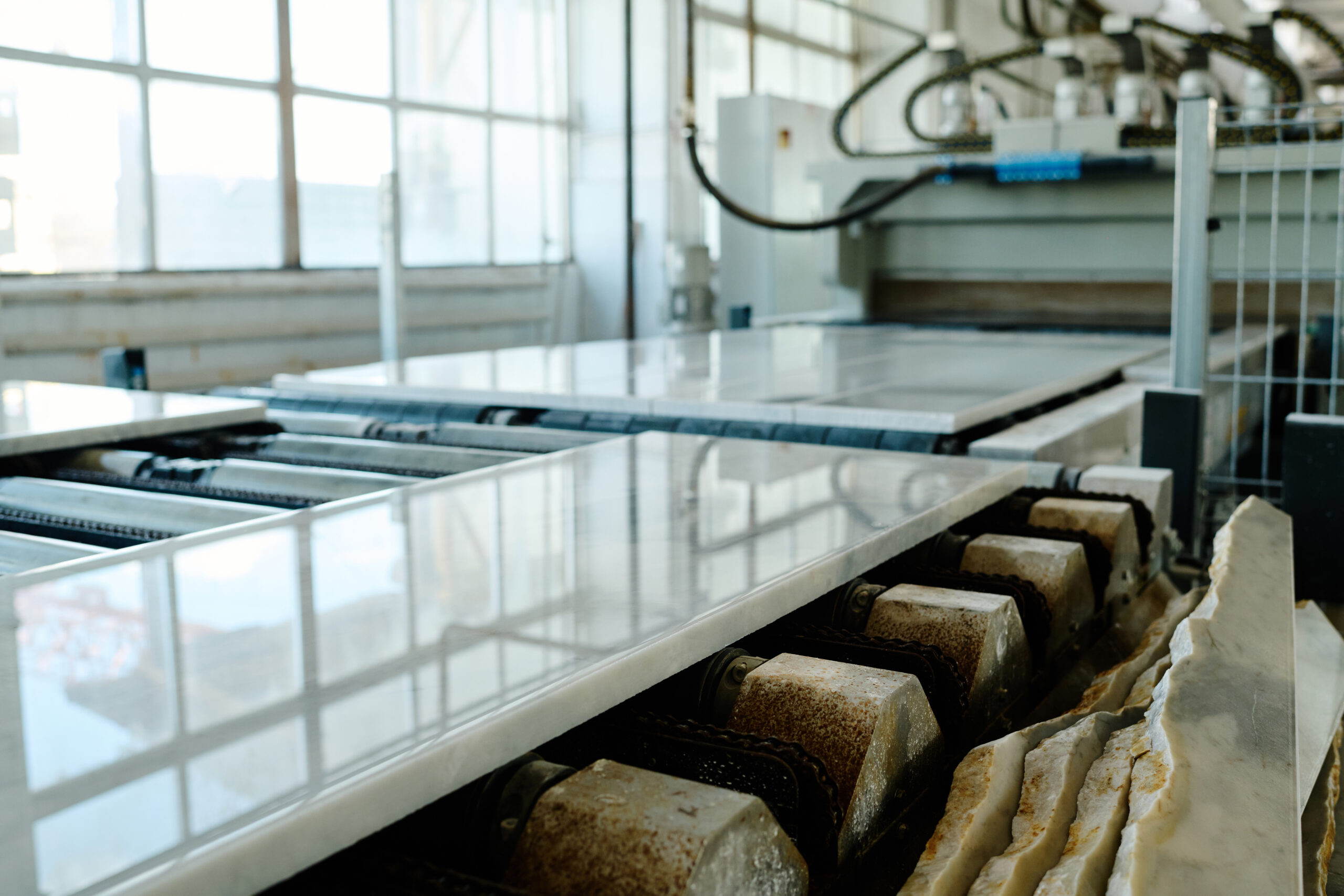


Engineered stone has become the most popular countertop material in the U.S. due to its affordability, durability and aesthetic appeal. These products contain a wide compositional range of silica, from negligible amounts to more than 80% silica by volume (or 90% by weight, given that the non-silica components of engineered stone, like resin, are typically less dense than silica).
Engineered stone has drawn attention as an occupational concern due to incidents of silicosis in the countertop fabrication industry and potentially high silica content in comparison to some natural stones, for example marble and limestone (~1-5% silica by weight/volume). It should be noted that many popular natural stone countertop materials like quartzite (90-99% by weight/volume), soapstone (~67% by weight/volume), sandstone (60-90% by weight/volume), granite (20-60% by weight/volume) and flint (87-99% by weight/volume) can contain comparable levels of crystalline silica. Other common materials like concrete and mortar may also contain substantial silica fractions (typically 25-70%).
According to a recent study, 32-43% of slab materials for new or upgraded countertops over the last three years were engineered stone followed by granite (15-20%), quartzite (10-11%), butcher block (5-9%), soapstone (3-4%) and marble (3-4%)
Recent clusters of silicosis among small workshops, that often employ vulnerable populations, highlight the health implications if proper protocols and controls are not implemented. The fabrication of high-silica-containing stones (engineered or natural) without proper controls can generate airborne respirable crystalline silica concentrations, hundreds of times greater than regulatory exposure limits. On the contrary, these operations can be performed safely when proper industrial hygiene protocols and engineering controls are in place.
Respirable Crystalline Silica Health Effects
Airborne respirable crystalline silica particles, a result of manipulating silica-containing materials, can penetrate deep into the lungs and, at sufficient doses lead to inflammatory responses, epithelial damage and, over time, develop silicosis.
Epidemiology studies have identified a dose-response relationship between cumulative respirable crystalline silica exposure and silicosis. Several epidemiology studies show that disease risk is minimal below silicosis threshold exposures (near the OSHA permissible exposure limit of 0.05 mg/m3). In a review of the literature, there is no convincing evidence that the respirable crystalline silica produced by engineered stone is more potent for silicosis than the respirable crystalline silica produced by natural stone or other common sources.
Respirable Crystalline Silica Exposure
Although it is easily assumed that higher silica containing materials release concentration of respirable crystalline silica, in our review of the literature, this is not such a straightforward assessment. A wide range of concentrations are plausible in the stone fabrication industry, depending on the use and design of engineering controls (wet methods, local exhaust ventilation), respirators, task (cutting, grinding, polishing, measuring, layout, installation, housekeeping, etc.), tools and the material properties of the slab.
For example, under identical controlled conditions, granite generated more total dust per cut during the same fabrication task compared to engineered stones. Material hardness appeared to drive this phenomenon as the resins used in engineered stones made it softer than many natural stones. Recent studies suggest that engineered stones and granite result in similar respirable crystalline silica concentrations under the same fabrication techniques, despite engineered stones typically having a greater silica content.
Rising Case Reports in Small Shops Highlight Importance of Protective Measures
Accelerated silicosis may result in situations with extraordinarily high exposures, not representative of standard or compliant workplace practices. Recent increases in reported silicosis cases, particularly in California, Texas, Colorado and Washington, have been attributed to occupational exposure during stone fabrication. These cases have emerged in smaller, often unregulated or under-regulated facilities – not across the broader industry where numerous employers have implemented substantial protective measures.
Although reports of silicosis in engineered stone workers are alarming, they primarily reflect the critical nature of implementing known protective measures rather than inherent dangers of the material itself.
How TRC Can Help
TRC’s practitioners experienced in Strategic Health Sciences have conducted more than 1,000 exposure assessments and risk characterizations across a wide array of occupational settings. Our work in silica-exposed environments has applied principles endorsed by the National Academies of Science, employing air dispersion modeling, dose reconstruction and health effect quantification to support litigation, regulatory compliance and industrial hygiene evaluations.
If you are navigating litigation, employer responsibility, regulatory questions, or health risk evaluations involving engineered stone or respirable crystalline silica, we can provide the scientific clarity necessary for informed decision-making.