




Challenge
A Rhode Island municipality required hydrogeologic consulting services to improve fish passage and public access at a river dam. The project was one of the final steps in a statewide effort to restore migratory fish routes, construct fish ladders and improve aquatic habitat to support spawning and nursery grounds. As the final dam in a long-term restoration initiative, the project attracted significant public visibility and community interest. Residents and stakeholders closely monitored potential impacts, so the town needed defensible scientific analysis to determine whether lowering the existing dam impoundment had the potential to adversely affect nearby private potable water wells.
The goal was to assess how lowering the dam might impact groundwater within the local aquifer system. Specifically, the client needed to identify nearby properties, especially those upstream of the dam, that could be susceptible to changes in groundwater levels. The results would inform regulatory permitting, stakeholder communication and funding decisions. Timely completion was critical. The modeling analysis would support regulatory approvals and help secure federal grant funding necessary to maintain project momentum. Without a rigorous and transparent technical evaluation, the client risked delays, increased stakeholder opposition and potential funding impacts.
Solution
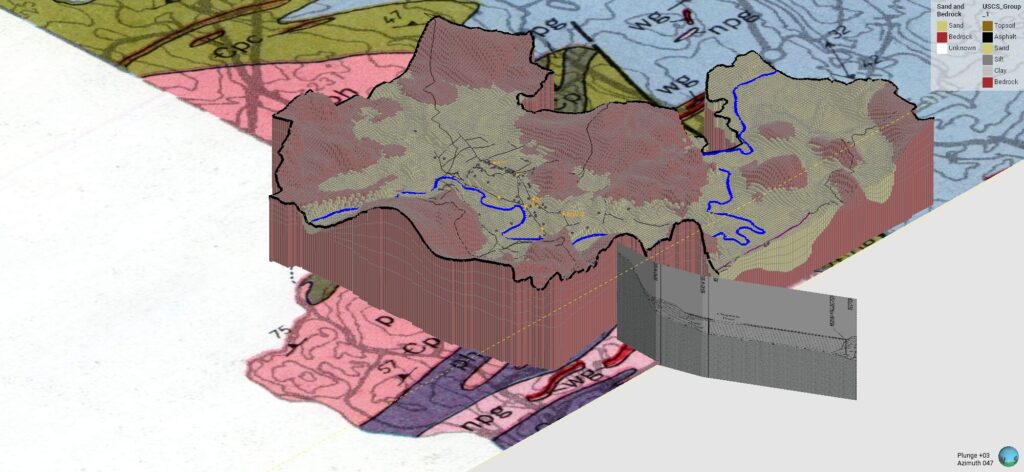
TRC developed and implemented a modern, integrated hydrogeologic modeling workflow centered on a next-generation, dynamic digital 3D conceptual site model (3D CSM) which served as the central workspace and archive for the project. Historical datasets including topographic information, hydrogeologic data, GIS layers, borehole logs and technical reports were synthesized within a unified 3D framework. The team used this environment to visualize complex subsurface conditions, evaluate data relationships and refine the hydrogeologic conceptual model.
The 3D geological framework developed in Leapfrog Works was then used to initialize and support groundwater flow modeling in Groundwater VISTAS running MODFLOW to simulate steady state hydraulic responses under a defined dam lowering scenario. The 3D CSM also functioned as a post-processing platform, enabling visualization and communication of model outputs in a clear and technically robust manner.
TRC enhanced efficiency and technical rigor through the strategic use of generative AI, automation and internally developed GPT tools. These technologies supported:
- Initial visual and flow model conceptualization and setup
- Automated input file creation
- Summarization, search and import of historical report information
- Automated download and preparation of GIS basemaps for model integration
- Automated digitization of historical map features
- Evaluation and comparison of alternative quantitative hydrogeologic approaches
- Brainstorming and refinement of technical solutions
- Software troubleshooting and interpretation of error messages
- Acceleration of MODFLOW output review to support model calibration and convergence
By combining advanced 3D visualization, established groundwater modeling platforms and AI-enabled knowledge acceleration, TRC delivered a transparent, technically defensible and highly communicable solution based on sound science.
Results
The modeling effort helped the municipality identify and categorize private potable water wells based on hydraulic susceptibility to the proposed dam lowering. This structured, tiered framework provided a clear basis for risk evaluation and decision-making.
The results have been actively used in public hearings and community engagement efforts. The 3D visualizations and model outputs helped communicate complex hydrogeologic concepts in a format accessible to regulators, stakeholders and concerned residents. This transparency supported informed dialogue, collaboration and strengthened stakeholder confidence.
The project delivered measurable value by:
- Supporting regulatory permitting and compliance
- Securing and allocating federal grant funding
- Reducing decision risk through improved data integration and early-stage quality control
- Accelerating model development and calibration through AI-assisted workflows
- Enhancing stakeholder engagement and collaboration through clear 3D visualizations and targeted animations
A key best practice emerging from this work is the use of a live, dynamic 3D CSM as the central modeling workspace and nexus for all graphics generation. Compared to traditional GIS-centric workflows, this integrated method improves data synthesis, enables intuitive QA and QC during model development and identifies conceptual issues early in the process.
Coupling advanced 3D visualization with Groundwater VISTAS and MODFLOW for established numerical modeling provides a complementary and efficient modeling ecosystem. In the hands of TRC’s practitioners, generative AI further accelerates interpretation, troubleshooting and technical refinement.
By adopting a modern, transparent and collaborative modeling approach, TRC helped the client advance a high-profile environmental restoration project while protecting local water supplies and strengthening community trust.