




Why your worst feeders might not require new technology, just new logic
Here’s a scenario most distribution engineers know well; a tree branch drops on a conductor at the end of a rural feeder. A recloser trips and eight hundred customers go dark. A crew drives forty-five minutes to patrol the line, the control center is confused, another thirty to locate the fault and, an hour later, your reliability metrics takes a hit that shows up in your next regulatory filing. After performing an event analysis, you find that coordination margins were already too tight to add more protection for future mitigation.
Now imagine the same fault with an additional recloser. Two reclosers trip together. Sequential reclosing logic operates and the one closest to the fault locks out, isolating just that segment. This all happens without the need for more coordination margin. Hundreds fewer customers see an interruption. The crew still responds, but they’re patrolling and addressing a smaller outage and your reliability metrics tell a very different story.
That’s not a simulation or a concept demo. It’s exactly what happens currently on distribution circuits across an entire utility system spanning more than a thousand reclosers. This is the result of a protection engineering team that refused to accept a long-standing industry limitation as permanent and partnered with TRC to build a better solution. The technology that made it possible required no communications network, no ADMS integration and no broadband infrastructure. Just reclosers, programmed smarter.
The Coordination Ceiling Most Utilities Have Already Hit
When a fault occurs on a distribution feeder, the goal is simple: isolate the smallest possible segment and restore service to the rest of the feeder as fast as possible. Sectionalizing devices, primarily reclosers, make that a reality, reducing the number of customers impacted by any single fault.
But traditional time-overcurrent coordination puts a ceiling on how far this strategy can go. Each new recloser must fit within a shrinking coordination window, defined by substation limitations and downstream protective equipment. Adding a third or fourth recloser shrinks the window even further, making coordination increasingly difficult to achieve. With a limited ability to deploy a higher density of protective equipment, reliability improvements become increasingly more difficult.
Eventually, utilities run out of coordination margin. Additional devices may be installed but configured as manually operated switches without automated protection settings because there is no feasible way to coordinate them into the scheme. The result is a feeder that appears optimized on paper but cannot isolate faults efficiently, leaving more customers at risk than necessary. Most utilities with mature distribution systems have already hit a limit to protection density on distribution feeders and have accepted it as an engineering reality. Whether it’s rural lines spanning miles or urban circuits navigating dense infrastructure, utilities must ask one simple question: what if coordination didn’t have to be limited by the first trip?
A Different Philosophy: Coordinate on the Reclose, Not the Trip
The answer to that question is Sequential Reclosing (SR), a protection scheme that sidesteps the coordination ceiling by changing when coordination happens.
Instead of trying to coordinate devices on the initial fault trip, SR lets multiple reclosers trip simultaneously and coordinates them on the reclose. After a fault, predetermined devices reclose one at a time from upstream to downstream, each waiting for the one before it to successfully close and restore healthy voltage. The device that closes into the fault trips and locks out. Every upstream device has reset to a coordinated protection curve, so it holds closed while the device closest to the fault trips. The fault is isolated to the smallest possible segment, automatically.
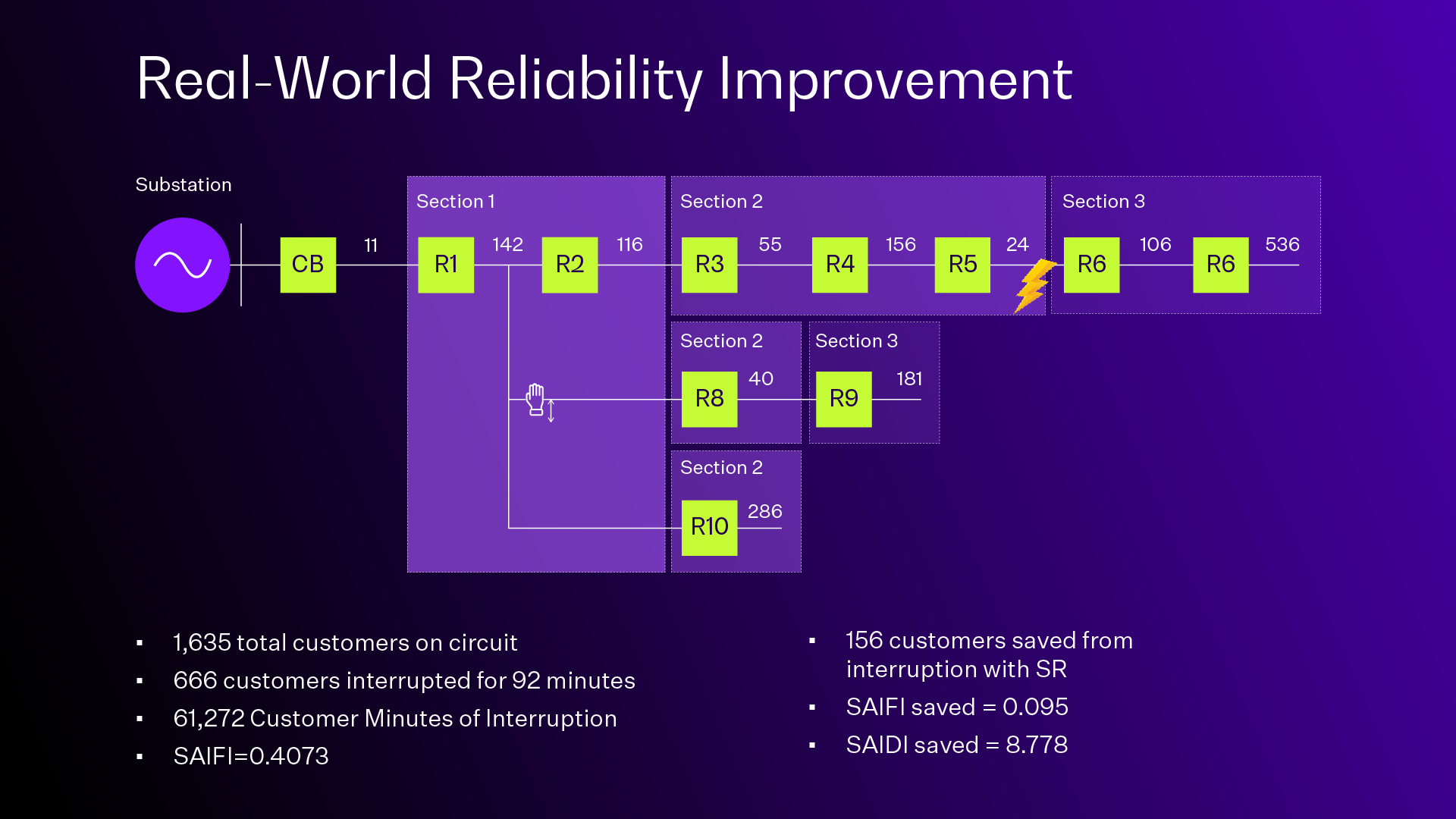
Because coordination happens during restoration rather than the initial trip, reclosers within a section can share identical protection settings. There’s no need to stack distinct curves within a shrinking window. This allows any number of reclosers to be installed in series and they will all coordinate seamlessly.
The logic that drives this lives inside the reclosers themselves: voltage sensing, curve switching and timing delays. There is no peer-to-peer communication between devices, no central controller and no ADMS issuing commands. Each recloser reads local measurements and acts accordingly, which is why this works just as well on a rural feeder without telecom infrastructure as it does on a suburban circuit with full SCADA coverage.
For utilities integrating DERs like solar or wind, SR adds resilience without complexity. As DER penetration increases, protection requirements and number of devices are also impacted. SR alleviates concerns of coordination with this added density of equipment to the system.
A Critical Advantage for Storm Response
Major storm events place distribution systems under their greatest stress. They also create the exact conditions where communications networks become unreliable. Towers can be damaged, fiber lines severed and cellular networks overwhelmed. When this happens, traditional FLISR schemes and other communications-dependent automation may become unavailable at the very moment they are needed the most.
SR doesn’t have this vulnerability. Because every recloser makes its decisions based solely on local voltage measurements, the scheme operates identically whether communications networks are fully functional or completely down. Loss of voltage on the line is the signal that something is wrong, triggering the restoration sequence automatically. There’s nothing external to fail.
Another major benefit is that SR circuits can operate flawlessly forward and reverse through any of the tie points that exist on distribution circuits. This is achieved without additional engineering complexity, coordination, or settings.
In the storms that stress a system the most, when communications-dependent schemes go quiet, SR keeps working. That’s not a secondary benefit. For many utilities, it may be the most important.
What Real-World Deployment Looks Like
The real test of any reliability strategy is how it performs on an energized feeder. SR has now been deployed on over a thousand reclosers across operating utility systems.
In one documented fault event on a feeder serving over 1,600 customers, a permanent fault near the end of the line triggered multiple reclosers. With SR in place, the scheme isolated the fault to a downstream segment, keeping the interruption to roughly 40% of the feeder’s customers. Without SR, the same fault would have interrupted more than 50% of customers. The difference translated to an improvement of nearly 19% in SAIFI for that event, and crews were spared patrolling nearly two additional miles of rural line to find a fault that the scheme had already localized for them.
In a separate event, a temporary fault just outside the substation caused every downstream SR recloser to open on undervoltage. When the substation breaker successfully reclosed on the cleared fault, healthy voltage cascaded back through the feeder and all ten reclosers restored in sequence. The entire process was completed in under 30 seconds, well below the five-minute threshold that counts toward SAIFI and SAIDI metrics.
Results from the U.S. Department of Energy’s Smart Grid Investment Grant Program show that distribution automation and self-healing feeder technologies can significantly improve reliability. In one example, Chattanooga’s electric power board (EPB) reported roughly 20% reductions in SAIDI and 30% reductions in SAIFI after deploying automated feeder switching and restoration schemes. During major storms, the technology also avoided tens of millions of customer-minutes of interruption and accelerated restoration timelines.
Why This Matters Beyond the Engineering Room
SAIDI and SAIFI used to live primarily in engineering reports. Today they drive regulatory incentives, inform rate case outcomes and appear on board-level dashboards. Regulators in many jurisdictions are increasingly focused on the worst-performing 3–5% of feeders and expect utilities to demonstrate concrete, quantifiable plans to address them.
Sequential Reclosing is well-suited to correct that problem because it’s a repeatable design pattern. Once you’ve developed a standard settings template for a feeder type, new reclosers can be added to an existing SR section without a full re-study. The engineering overhead that typically increases with each new device is largely eliminated. That matters both for capital efficiency and for workload, especially as engineering teams are being asked to absorb DER integration studies on top of everything else.
For utilities with rural territory or limited communications coverage, SR also offers something that full FLISR deployment often can’t: feeder-level self-healing that doesn’t depend on a telecom buildout. Reliability improvement is available now, using equipment crews already understand, on a timeline that fits within a single capital budget cycle rather than a multi-year program. Compared to communications-heavy FLISR, SR is often cheaper to deploy while delivering extremely similar restoration speeds, ideal for cash-strapped co-ops or municipals.
Getting Started: Building Something That Lasts
One of the most common questions utilities ask when they first consider SR is whether it requires replacing existing infrastructure. The short answer is no.
SR is vendor-agnostic. It can be implemented across different brands of reclosers and controllers making it compatible with the mixed-inventory reality of most distribution systems. Existing reclosers that lack voltage transformers can serve as section heads, with SR-capable devices installed downstream. Standard settings templates allow new devices to be added to an existing section with minimal to no re-engineering. The main operational adjustments are training crews on the new reclose behavior. These are well-understood transitions that utilities have navigated successfully.
But perhaps the most underappreciated benefit of SR is its impact on every subsequent decision. Adding a recloser to an existing section doesn’t require a new coordination study. Tying feeders together doesn’t break the scheme or cause miscoordination. With SR logic, miscoordination, the risk that compounds with every device you add under a traditional scheme, is designed out. When your protection philosophy is built on SR, the answer to “can we add another device?” is yes, every time. That’s not just a reliability win for today. It’s a protection foundation that won’t need to be re-engineered every time your system evolves.
Related Services
How TRC Can Help
If your utility is carrying worst-performing feeders into its next regulatory cycle, hitting coordination ceilings that limit sectionalizing, or seeking reliability improvements without a broadband prerequisite, TRC’s System Protection team can help you take the next step.
We bring hands-on experience deploying SR at scale, from developing protection standards and settings templates, to engineering individual feeder designs, to navigating the operational transitions that make implementations stick. We’ve seen these schemes perform under real fault conditions and we know what it takes to get from concept to commissioned feeder.
Reach out to us for a complimentary initial consultation. We’ll assess your specific feeders, identify where SR delivers the most impact and map out a practical path forward, on a timeline and budget that works for your organization.
Embrace The Shift
Partner With TRC’s Tested Practitioners
