




Tolls in express lanes are set through a system known as dynamic or variable pricing. Rates adjust in real time, based on traffic conditions, vehicle volumes and speed targets. When congestion builds and lane usage approaches capacity, the toll increases to manage demand and maintain free-flow speeds. When traffic eases, the toll decreases, encouraging more drivers to use the lane.
Traffic congestion is a persistent challenge in urban and suburban areas. Traditional lane expansion can be limited by construction costs and environmental impacts and impacts on long-term level of service can vary. Express lanes can be a strategic solution. By using dynamic tolling, managed-lane frameworks and real-time data analytics, agencies can optimize lane performance while reinforcing sustainable infrastructure investment.
Understanding Express Lanes and Managed Lanes
Express lanes are highway lanes designed to optimize traffic movement. They can operate as high-occupancy vehicle (HOV) lanes, tolled managed lanes or hybrid lanes. Unlike general-purpose lanes, express lanes are actively monitored and controlled. Express lanes often include preferential access or discounted tolls for HOVs, transit vehicles or other shared-mobility users. These incentives encourage more efficient lane usage, which supports sustainability goals.
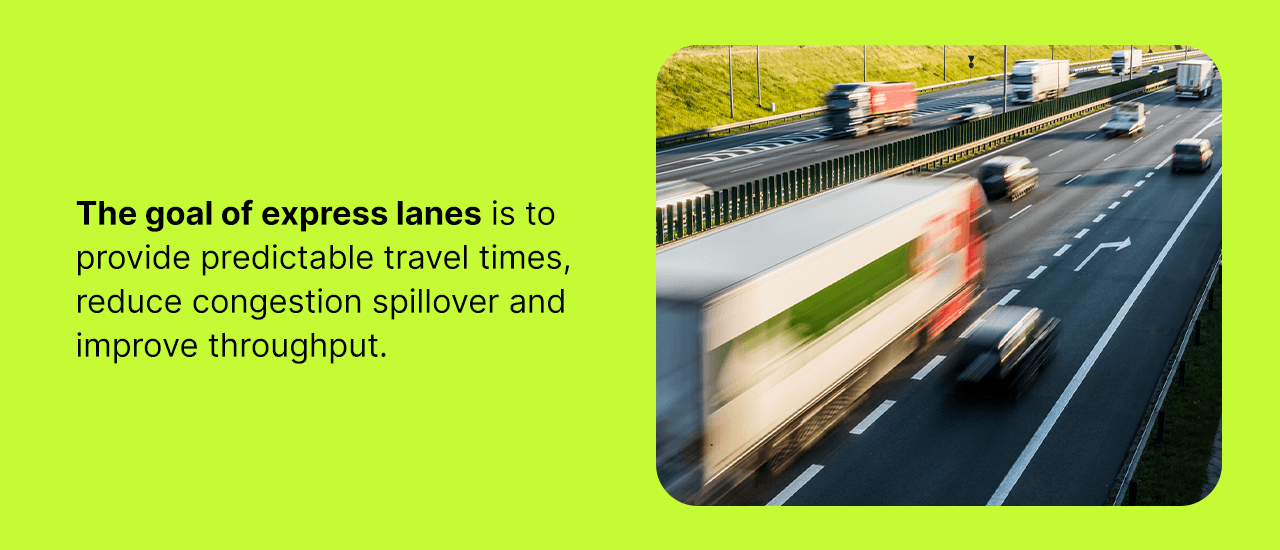
The goal of express lanes is to provide predictable travel times, reduce congestion spillover and improve throughput. Physical separation and electronic tolling are often used in conjunction with these lanes to maintain operational efficiency. According to the Federal Highway Administration, express lanes increase average speeds while reducing delays in adjacent general-purpose lanes.
The Role of Express Lanes in Modern Transportation
As regional populations grow and travel demand intensifies, conventional highway lanes alone struggle to meet mobility and reliability requirements. Express lanes create targeted capacity, enhance travel time predictability, and generate revenue to support maintenance and upgrades. Other reasons for express lanes include:
- Freight and transit growth demand predictable travel times and dedicated lane capacity.
- Right-of-way limitations or prohibitive costs associated with widening general-purpose lanes.
- A desire to support sustainability objectives, including lower emissions, reduced idling and improved air quality.
Express lanes also strengthen regional economies. Reliable freight and commuter mobility enhance business productivity, support workforce access and attract investment. The ability to move people and goods efficiently becomes a long-term economic advantage for growing metropolitan areas.
Overall, express lanes offer long-term community benefits by promoting fiscal sustainability, environmental improvement, accessibility, safety and economic vitality.
How Express Lanes Help With Traffic Flow
The operational benefits of express lanes stem from two essential mechanisms — demand-responsive pricing or dynamic tolling and HOV incentives. These mechanisms align with lane usage and corridor performance targets. They also allocate capacity intelligently while maintaining throughput, even under heavy demand.
Dynamic Tolling
When general-purpose lanes approach service breakdown, toll rates increase to moderate demand and protect target speeds in the express lane. Conversely, when demand is low, managed lanes alleviate costs to encourage usage and maximize lane use. Research shows that managed lanes with demand-responsive pricing maintain a higher service level and improve travel-time reliability in both express and adjacent general lanes.
By applying price signals linked to real-time data, agencies convert express lanes into performance-managed assets. This approach enhances reliability, supports funding sustainability and delivers better mobility outcomes without requiring full general-purpose widening.
Relieving Congestion With Managed Lanes
One of the advantages of express lanes is the relief they provide from congestion. By diverting drivers into controlled lanes, pressure on general-purpose lanes decreases. This means less time is spent in stop-and-go traffic and drivers experience a smoother, more consistent experience. This is especially helpful during rush hour or when there are unexpected delays due to accidents or construction.
Studies show corridors with express lanes see improved speeds across all lanes, not just the managed lane. This effect lessens stop-and-go traffic and stabilizes flow. Managed lanes create capacity without widening the entire roadway.
Providing Reliable Travel Times
Express lanes offer predictable travel times, a critical factor for commuters and commercial traffic. By maintaining speeds above threshold levels, these lanes attract drivers seeking reliability.
This reliability helps to reduce stress and wasted time, making express lanes a valuable asset for both individuals and the economy. By avoiding unexpected delays, drivers can optimize their routes and reduce fuel consumption. This contributes to a more efficient and sustainable transportation system. The predictability is a major draw for those who value their time and need to stick to a schedule.
Reliable flow reduces incidents caused by sudden congestion, while improving planning for freight, transit and emergency vehicles. Agencies benefit from more stable corridor performance and fewer peak-hour bottlenecks.
Maintaining Express Lane Safety
By regulating demand through dynamic tolling and eligibility controls, express lanes maintain steady, free-flowing speeds for vehicles. This reduces sudden braking and lane changing, common causes of collisions in congested general-purpose lanes. Many express lanes also use buffer zones, flexible barriers or concrete medians to define boundaries between managed and general lanes. These features limit weaving and discourage unsafe merging.
Dedicated entry and exit points prevent last-minute maneuvers. Clear signage, overhead message boards and pavement markings provide early guidance to drivers. Additionally, express lanes typically incorporate enhanced enforcement and operational protocols. Patrol units and service vehicles can quickly access lanes, and communication between control centers and responders streamlines this coordination.
Data-Driven Management
Effective express-lane systems rely on data collection, real-time monitoring and adaptive control frameworks. Modern corridors use sensor technologies, which include loop detectors, radar, Bluetooth or Wi-Fi vehicle tracking, CCTV and variable message signage. These tools capture speed, volume, occupancy and incident status.
Real-time monitoring lets agencies continuously evaluate corridor status. If general lanes decelerate or incident conditions emerge, toll algorithms can adjust pricing, ramp access or lane eligibility. Similarly, analytics and forecasting enable agencies to anticipate demand surges, such as freight peaks or special events and make proactive adjustments.
From an operational asset-management standpoint, the data-driven model offers many benefits to managed lanes:
- Validates travel-time reliability performance and supports stakeholder accountability.
- Tracks incident-response impact, safety outcomes and emissions related to smoother traffic flow.
- Enables life cycle planning by linking toll revenue, operations performance and asset renewal strategies.
- Supports decision-making based on real usage and performance outcomes rather than default assumptions.
By integrating design, construction and operational phases with analytics, agencies shift express lanes from static infrastructure to dynamic managed networks. This transition strengthens corridor resilience, allows for continuous improvement, and supports mobility outcomes, sustainability and funding goals.
Benefits for Public, Private and Government Clients
Express lane benefits are far-reaching and these managed-lane systems support mobility, funding and performance objectives.
Local Advantages
Residents, commuters and visitors benefit from reduced congestion, improved reliability and higher-occupancy travel. Travel-time predictability also enhances commuter experience and strengthens access to jobs, services and transit. Reduced idling and smoother traffic flow contribute to improved air quality and lower emissions.
Private Sector and Business Benefits
Freight providers, logistics operations and commercial fleets value corridors with higher reliability and reduced delay. With their dedicated lane capacity, express lanes enhance schedule integrity and reduce operating costs by improving traffic flow. This also gives businesses that rely on timely deliveries or supply chain responsiveness a competitive advantage. Express lanes support public-private partnership models by bringing private capital and innovation into mobility project delivery.
Government and Agency Outcomes
Transport agencies, regional authorities and state agencies face demands to manage mobility, emissions, funding and infrastructure renewal. Express lanes allow these agencies to maximize existing capacity instead of immediately resorting to widening. Through reduced turbulence and improved incident response, these lanes support predictable travel times and enhanced safety, with dedicated revenue mechanisms through tolling, which lowers sole reliance on tax-funded infrastructure.
Data-driven operations also allow for continuous evaluation and adaptation. For agencies operating under constrained budgets and increasing performance expectations, express-lane systems provide a strategic asset. When integrated with regional mobility plans, transit operations and shared-mobility initiatives, they become central to resilient transportation networks.
Related Services
Case Studies: Express Lanes in Action
These express lane projects demonstrate the potential for managed-lane systems to deliver measurable improvements in mobility, safety and sustainability. Each initiative is driven by a clear operational challenge with solutions developed through rigorous planning, design and construction phases. They show how express lanes can evolve from concept to an infrastructure asset and how agencies can translate corridor improvements into practical transportation enhancements.
San Bernardino County Transportation Authority I-15 Freight and Express Lanes
The I-15 freight and express lanes initiative addresses one of the most congested freight bottlenecks in the U.S. The I-10/15 interchange in Southern California’s Inland Empire handles 50% of the interstate truck traffic for the region. TRC serves as the prime construction management consultant on this project, which extends toll-managed express lanes roughly 8 miles into San Bernardino County, from the Riverside County line toward Rancho Cucamonga, and incorporates:
- Bridge widenings
- Auxiliary lanes
- Retaining walls
- Drainage improvements
- Soundwalls
- Operational enhancements
This design-build delivery focuses on freight-movement reliability, reduced travel time and smoother corridor performance across commuter and logistics traffic.
Los Angeles Metropolitan Transportation Authority I-105 Express Lanes
In Los Angeles County, the median-lane widening project adds a dedicated express lane in each direction across I-105, from Sepulveda Boulevard to Studebaker Road. TRC provided design services for the project, which included:
- Widening by 25 feet
- Auxiliary lanes
- Express lanes direct connectors
- Rapid construction techniques
This construction plan reduces disruption. Service reliability and maintenance-funding resiliency are also built into the design-deliver-operate life cycle through toll-based operations and durable asset design.
San Bernardino County Transportation Authority I-10 Express Lanes Contract 2
TRC leads the design delivery of this 11-mile segment of I-10 between the I-15 interchange in Ontario and just east of Pepper Avenue in Colton. It features one express lane in each direction, designed for future expansion. This proactive design-management strategy delivers plans, specifications and estimates documentation that:
- Accommodates a future second express lane
- Integrates right-of-way planning
- Supports long-term corridor growth without large-scale disruptive widening
Close coordination has been required among all disciplines to make sure all facilities can be constructed with no conflicts. TRC, working closely with surrounding cities, Caltrans, and SBCTA, is also developing a comprehensive Transportation Management Plan and construction staging sequencing that balances short-term and long-term impacts to the traveling public with the safe, efficient delivery of this highway construction project without compromising public or worker safety, or the quality of the work being performed on the State Highway System.
Frequently Asked Questions About Express Lanes
Express lanes combine engineering, policy and operations to improve how people and goods move through congested corridors. They’re designed to manage demand and create self-sustaining funding for roadway maintenance and operations. Here are answers to some common questions about how the system works.
Eligibility to use express lanes varies by corridor design and operational policy. In many systems, all passenger vehicles can access the lane by paying the posted toll electronically. HOVs, vanpools and transit buses may get discounted or toll-free access to encourage carpooling and promote shared mobility. Commercial and freight vehicles may be permitted in certain corridors, depending on pavement design and operational standards. Motorcycles often use express lanes toll-free.
Express lanes contribute to safety by reducing speed variations and smoothing traffic flow. Consistent travel speeds minimize the likelihood of rear-end collisions and sudden lane changes. Dedicated access points and clear signage help drivers make informed decisions well before entry or exit. Additionally, managed lanes often include enhanced incident-management protocols, continuous monitoring and automated detection systems that let operators quickly respond to breakdowns or crashes.
Trust TRC for Lasting Results
Express lanes address traffic challenges by offering managed capacity, enabling demand-signal control, supporting mode-shift incentives and linking mobility investment with operational funding.
At TRC, we understand the need for agile, adaptable engineering and construction management for express lanes. Our services include road, bridge and highway design, fabrication inspection, civil engineering and construction management and inspection services. We prioritize a safety-first culture, committing to prevention through reliable design and construction. With hundreds of miles of successful highway projects, you can trust TRC with your resilient transportation infrastructure needs.