






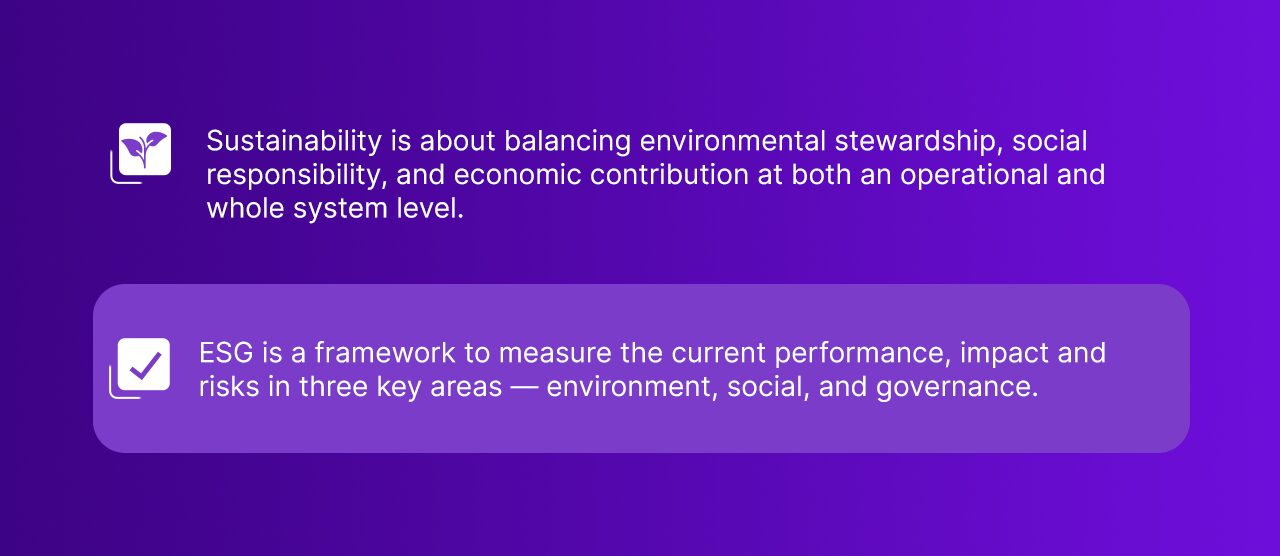
Understanding how Environment, Social and Governance (ESG) and sustainability differ—and how they complement one another—is essential for informed decision-making and effective strategic direction. Sustainability represents the desired future state—the long-term vision a company aims to achieve. ESG, by contrast, provides a framework to measure current performance, impacts, and risks. Together, ESG and sustainability help organizations identify emerging trends, manage risks and opportunities, and adapt their strategies to achieve long-term value.
This distinction clarifies how sustainability sets the direction while ESG translates that ambition into measurable performance—creating a more disciplined approach to risk management, compliance, and long-term value creation.
Comparing Sustainability vs. ESG
If you’re looking to enhance your practices, it’s important to understand ESG and sustainability similarities, their differences, and how they work together to benefit business outcomes.
What Is ESG?
Investors consider ESG performance as one component in their assessment of a company’s investment viability. ESG rankings are a set of ratings and standards that score a company’s operations, risks and practices in three important areas — environmental, social and governance:
Environmental: This aspect examines how a company impacts and manages its interactions with the natural environment. It considers factors like carbon emissions, waste management, water stewardship, biodiversity, and resource use.
Social: The social pillar focuses on how a company manages relationships with people and communities. It includes employee health and wellness, training and development, health and safety, community engagement and navigation through issues like customer satisfaction and labor practices.
Governance: This element provides structure and process to a company’s leadership, Executive, and Board, and how it ensures compliance, cybersecurity, transparency and ethical practices. Depending on the sector, governance may extend to product compliance.
The ESG rankings of a company can be compared with their peer companies by the investor during the investment evaluation process. Companies with strong ESG practices (sustainability, climate adaptation and resilience, and ethical impact) are often seen as more responsible and less risky, making them attractive investments. These companies show a willingness to commit their efforts and resources to goals that achieve cost-efficiency and benefit organizations in other ways, including:
- Enhanced reputation: Companies that actively manage, measure, and transparently communicate their ESG impacts, often enjoy a better public image that fosters trust and loyalty among consumers and stakeholders.
- Risk management: ESG practices help identify and mitigate risks related to environmental impacts, social issues and governance challenges, thereby protecting the company from potential legal or regulatory issues and brand erosion.
- Operational efficiency: ESG initiatives often drive innovation, leading to the development of new products and services that meet emerging market demands and create long-term value.
What Is Sustainability?
Sustainability is a broader concept that integrates economic, environmental, and social considerations into both daily operations and long-term business strategies. By adopting sustainable practices, companies position themselves for lasting success while fostering social well-being and reducing their environmental footprint, ensuring resilience in a changing world. It focuses on balancing three key dimensions — the environment, society and economy.
- Environmental sustainability involves managing resources responsibly, reducing environmental impact, and conserving biodiversity to ensure long-term resilience.
- Social sustainability is about identifying and managing business impacts, both positive and negative, on people and communities. It aims to create a just society where everyone can access basic needs and opportunities.
- Economic sustainability ensures businesses and economies can thrive over the long term while considering environmental and social impacts.
Sustainability is about making responsible choices that balance environmental stewardship, social responsibility, and economic success. It influences consumer preferences, manufacturing processes and technological advancements toward a more circular economy, ensuring a better quality of life for everyone now and in the future.
Implementing sustainability creates other advantages for organizations, including:
- Cost savings: Sustainable practices, such as energy efficiency and waste reduction, can lead to cost savings by minimizing resource use and reducing long-term operational expenses.
- Attraction and retention: Many employees, especially those in younger generations, prefer to work for companies with sustainable practices and a commitment to social responsibility. It can lead to higher job satisfaction and morale, increased productivity and lower turnover rates.
- Long-term business resilience: Focusing on sustainable practices can help companies better prepare for and respond quickly and safely to the impacts of climate change, resource availability and consumer preferences.
Companies that embrace sustainability will often collaborate with their industry, regulatory, academic, and supply chain partners, creating opportunities for capacity building and innovative solutions that benefit multiple sectors beyond their own which exponentially influence change and create value for stakeholders and shareholders alike.
Key Differences Between ESG and Sustainability
Both concepts share a common objective: balancing economic performance with environmental stewardship and social responsibility. While global frameworks may frame the “social” dimension around issues such as poverty and inequality, for many companies this dimension is more directly expressed through areas like workforce, health and safety, labor practices, and community impact—areas where organizations have clear influence and accountability.
Materiality plays a central role in connecting sustainability ambition with ESG performance. Organizations would not set long-term goals—such as a net-zero commitment—without identifying the issues that matter most to businesses and establishing metrics to measure progress over time. These material issues often align closely with enterprise risk management, reinforcing that sustainability and ESG are not parallel efforts, but integral to how organizations identify, prioritize, and manage risk.
ESG vs. Sustainability Reporting
Because each company is its own sector with its own unique goals, culture, and leadership, this creates significant variability in reporting, even within frameworks. The company’s maturity and place along the sustainability journey also becomes visible in their reporting. It is important to acknowledge that limited reporting does not mean lack of commitment.
However, due to the aforementioned issues, reporting on sustainability is often less standardized and can vary significantly among organizations. It may encompass qualitative assessments, broader initiatives, and even passion projects, making it harder to compare across companies. For example, a sustainability report may highlight a company’s community engagement efforts, environmental initiatives, and certifications but lack specific metrics or comparisons to industry peers.
When comparing a sustainability report to an ESG report, the latter uses specific metrics and standardized reporting frameworks to disclose performance in environmental, social and governance areas:
- Environmental metrics: These metrics evaluate a company’s impact on the environment and its efforts to mitigate that impact. Examples include carbon emissions, energy usage, water usage, waste management and biodiversity impact.
- Social metrics: The organization’s social aspects focus on employee diversity, health and safety, customer satisfaction, community impact and engagement.
- Governance metrics: These metrics assess a company’s governance structures and practices. They may include board diversity, executive compensation, ethical standards, shareholder rights and risk management.
Many sustainability reports will align to the GRI Standards, formerly known as the Global Reporting Initiative. The GRI standards provide detailed guidance to reporters across dozens of topical sustainability issues that reporters may identify as material.
The Regulatory Landscape
While sustainability initiatives across energy, waste, water and corporate governance may be subject to regulations, reporting itself for companies is often driven by voluntary commitments and corporate social responsibility efforts. The absence of global regulation or universally accepted standards can lead to variability in how sustainability is reported. Companies may adopt sustainability practices without formal regulatory requirements, focusing instead on their commitment to social and environmental responsibility.
In contrast, ESG is increasingly influenced by regulations and compliance requirements. Many countries are mandating ESG disclosures for publicly traded companies, and investors are demanding standardized reporting to assess risks and opportunities. One example is the European Union’s Corporate Sustainability Reporting Directive, which requires companies to disclose sustainability information (following the European Sustainability Reporting Standards framework) and impacts how businesses report their performance.

Integrate ESG and Sustainability With TRC
ESG and sustainability are essential frameworks businesses must navigate to enhance their operations and reputation. They’re both integral to managing risks related to environmental impact, social responsibility and governance issues. Effective communication with stakeholders is crucial for success in ESG and sustainability practices. Energy efficiency experts can provide customized guidance to help your business create actionable plans incorporating both frameworks to meet regulatory requirements and stakeholder expectations.
TRC provides sustainability advisory services tailored to your company’s unique needs to balance environmental, social and governance objectives, develop your strategy, and engage with your stakeholders. With more public disclosure requirements than ever before, we take a multidisciplinary approach to integrate global sustainability and ESG frameworks into your operations.
For more information on our EHS&S services, we invite you to get in touch with our sustainability consultants today.